
PG.1B, SEC 1, Alternate angles (50)
Quiz Summary
0 of 50 Questions completed
Questions:
Information
You have already completed the quiz before. Hence you can not start it again.
Quiz is loading…
You must sign in or sign up to start the quiz.
You must first complete the following:
Results
Results
0 of 50 Questions answered correctly
Your time:
Time has elapsed
You have reached 0 of 0 point(s), (0)
Earned Point(s): 0 of 0, (0)
0 Essay(s) Pending (Possible Point(s): 0)
Categories
- Not categorized 0%
- 1
- 2
- 3
- 4
- 5
- 6
- 7
- 8
- 9
- 10
- 11
- 12
- 13
- 14
- 15
- 16
- 17
- 18
- 19
- 20
- 21
- 22
- 23
- 24
- 25
- 26
- 27
- 28
- 29
- 30
- 31
- 32
- 33
- 34
- 35
- 36
- 37
- 38
- 39
- 40
- 41
- 42
- 43
- 44
- 45
- 46
- 47
- 48
- 49
- 50
- Current
- Review / Skip
- Answered
- Correct
- Incorrect
-
Question 1 of 50
1. Question
Topic: Angles on Parallel Lines.

Please have pen and paper handy to show workings out. 📝
📐 If , find angle .
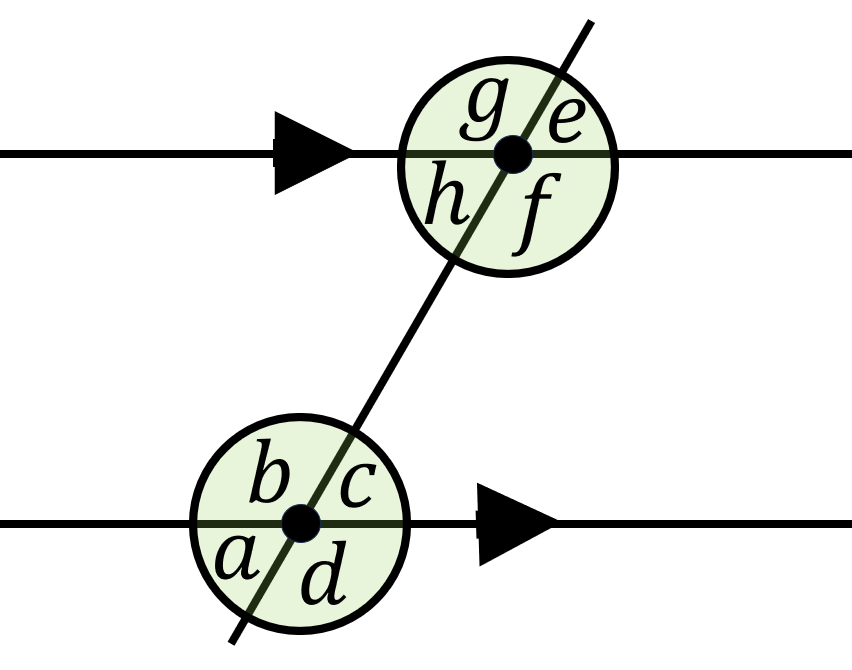
Use the diagram below.
-
g = °
⌨️ Enter your answer in the field provided.
CorrectIncorrectHint
💡 Key facts: right angle totals 90°, straight line totals 180°, full turn totals 360°, and vertically opposite angles are equal.
🔹 Alternate angles (Z-shape): In this diagram h and c are alternate interior angles, so h = c.
Also f and b are alternate interior angles, so f = b.
🔹 Corresponding angles (F-shape): Matching corners on the two intersections are equal, so d = f and c = e, and also a = h and b = g.
🔹 Interior or same-side angles (C-shape): Interior angles on the same side of the transversal add to 180°, so f + c = 180° giving f = 180° − c and c = 180° − f, and similarly b + h = 180° giving b = 180° − h and h = 180° − b.
These facts apply only when the lines are truly parallel, and if the lines are not parallel these equalities and 180° sums no longer hold.
The same angle rules work for parallel curved lines like concentric tracks or parallel arcs, but if the curves are not parallel the rules do not apply.
The arrow markings on the diagram tell you the lines are parallel, so you can safely use alternate, corresponding, and interior angle rules.
If there are no matching parallel markings or it is not stated in the question do not assume the lines are parallel and do not apply these rules.
-
-
Question 2 of 50
2. Question
Topic: Angles on Parallel Lines.
Please have pen and paper handy to show workings out. 📝
📐 If , find angle .
Use the diagram below.
-
d = °
⌨️ Enter your answer in the field provided.
CorrectIncorrectHint
💡 Key facts: right angle totals 90°, straight line totals 180°, full turn totals 360°, and vertically opposite angles are equal.
🔹 Alternate angles (Z-shape): In this diagram h and c are alternate interior angles, so h = c.
Also f and b are alternate interior angles, so f = b.
🔹 Corresponding angles (F-shape): Matching corners on the two intersections are equal, so d = f and c = e, and also a = h and b = g.
🔹 Interior or same-side angles (C-shape): Interior angles on the same side of the transversal add to 180°, so f + c = 180° giving f = 180° − c and c = 180° − f, and similarly b + h = 180° giving b = 180° − h and h = 180° − b.
These facts apply only when the lines are truly parallel, and if the lines are not parallel these equalities and 180° sums no longer hold.
The same angle rules work for parallel curved lines like concentric tracks or parallel arcs, but if the curves are not parallel the rules do not apply.
The arrow markings on the diagram tell you the lines are parallel, so you can safely use alternate, corresponding, and interior angle rules.
If there are no matching parallel markings or it is not stated in the question do not assume the lines are parallel and do not apply these rules.
-
-
Question 3 of 50
3. Question
Topic: Angles on Parallel Lines.
Please have pen and paper handy to show workings out. 📝
📐 If , find angle .
Use the diagram below.
-
b = °
⌨️ Enter your answer in the field provided.
CorrectIncorrectHint
💡 Key facts: right angle totals 90°, straight line totals 180°, full turn totals 360°, and vertically opposite angles are equal.
🔹 Alternate angles (Z-shape): In this diagram h and c are alternate interior angles, so h = c.
Also f and b are alternate interior angles, so f = b.
🔹 Corresponding angles (F-shape): Matching corners on the two intersections are equal, so d = f and c = e, and also a = h and b = g.
🔹 Interior or same-side angles (C-shape): Interior angles on the same side of the transversal add to 180°, so f + c = 180° giving f = 180° − c and c = 180° − f, and similarly b + h = 180° giving b = 180° − h and h = 180° − b.
These facts apply only when the lines are truly parallel, and if the lines are not parallel these equalities and 180° sums no longer hold.
The same angle rules work for parallel curved lines like concentric tracks or parallel arcs, but if the curves are not parallel the rules do not apply.
The arrow markings on the diagram tell you the lines are parallel, so you can safely use alternate, corresponding, and interior angle rules.
If there are no matching parallel markings or it is not stated in the question do not assume the lines are parallel and do not apply these rules.
-
-
Question 4 of 50
4. Question
Topic: Angles on Parallel Lines.
Please have pen and paper handy to show workings out. 📝
📐 If , find angle .
Use the diagram below.
-
b = °
⌨️ Enter your answer in the field provided.
CorrectIncorrectHint
💡 Key facts: right angle totals 90°, straight line totals 180°, full turn totals 360°, and vertically opposite angles are equal.
🔹 Alternate angles (Z-shape): In this diagram h and c are alternate interior angles, so h = c.
Also f and b are alternate interior angles, so f = b.
🔹 Corresponding angles (F-shape): Matching corners on the two intersections are equal, so d = f and c = e, and also a = h and b = g.
🔹 Interior or same-side angles (C-shape): Interior angles on the same side of the transversal add to 180°, so f + c = 180° giving f = 180° − c and c = 180° − f, and similarly b + h = 180° giving b = 180° − h and h = 180° − b.
These facts apply only when the lines are truly parallel, and if the lines are not parallel these equalities and 180° sums no longer hold.
The same angle rules work for parallel curved lines like concentric tracks or parallel arcs, but if the curves are not parallel the rules do not apply.
The arrow markings on the diagram tell you the lines are parallel, so you can safely use alternate, corresponding, and interior angle rules.
If there are no matching parallel markings or it is not stated in the question do not assume the lines are parallel and do not apply these rules.
-
-
Question 5 of 50
5. Question
Topic: Angles on Parallel Lines.
Please have pen and paper handy to show workings out. 📝
📐 If , find angle .
Use the diagram below.
-
f = °
⌨️ Enter your answer in the field provided.
CorrectIncorrectHint
💡 Key facts: right angle totals 90°, straight line totals 180°, full turn totals 360°, and vertically opposite angles are equal.
🔹 Alternate angles (Z-shape): In this diagram h and c are alternate interior angles, so h = c.
Also f and b are alternate interior angles, so f = b.
🔹 Corresponding angles (F-shape): Matching corners on the two intersections are equal, so d = f and c = e, and also a = h and b = g.
🔹 Interior or same-side angles (C-shape): Interior angles on the same side of the transversal add to 180°, so f + c = 180° giving f = 180° − c and c = 180° − f, and similarly b + h = 180° giving b = 180° − h and h = 180° − b.
These facts apply only when the lines are truly parallel, and if the lines are not parallel these equalities and 180° sums no longer hold.
The same angle rules work for parallel curved lines like concentric tracks or parallel arcs, but if the curves are not parallel the rules do not apply.
The arrow markings on the diagram tell you the lines are parallel, so you can safely use alternate, corresponding, and interior angle rules.
If there are no matching parallel markings or it is not stated in the question do not assume the lines are parallel and do not apply these rules.
-
-
Question 6 of 50
6. Question
Topic: Angles on Parallel Lines.
Please have pen and paper handy to show workings out. 📝
📐 If , find angle .
Use the diagram below.
-
f = °
⌨️ Enter your answer in the field provided.
CorrectIncorrectHint
💡 Key facts: right angle totals 90°, straight line totals 180°, full turn totals 360°, and vertically opposite angles are equal.
🔹 Alternate angles (Z-shape): In this diagram h and c are alternate interior angles, so h = c.
Also f and b are alternate interior angles, so f = b.
🔹 Corresponding angles (F-shape): Matching corners on the two intersections are equal, so d = f and c = e, and also a = h and b = g.
🔹 Interior or same-side angles (C-shape): Interior angles on the same side of the transversal add to 180°, so f + c = 180° giving f = 180° − c and c = 180° − f, and similarly b + h = 180° giving b = 180° − h and h = 180° − b.
These facts apply only when the lines are truly parallel, and if the lines are not parallel these equalities and 180° sums no longer hold.
The same angle rules work for parallel curved lines like concentric tracks or parallel arcs, but if the curves are not parallel the rules do not apply.
The arrow markings on the diagram tell you the lines are parallel, so you can safely use alternate, corresponding, and interior angle rules.
If there are no matching parallel markings or it is not stated in the question do not assume the lines are parallel and do not apply these rules.
-
-
Question 7 of 50
7. Question
Topic: Angles on Parallel Lines.
Please have pen and paper handy to show workings out. 📝
📐 If , find angle .
Use the diagram below.
-
g = °
⌨️ Enter your answer in the field provided.
CorrectIncorrectHint
💡 Key facts: right angle totals 90°, straight line totals 180°, full turn totals 360°, and vertically opposite angles are equal.
🔹 Alternate angles (Z-shape): In this diagram h and c are alternate interior angles, so h = c.
Also f and b are alternate interior angles, so f = b.
🔹 Corresponding angles (F-shape): Matching corners on the two intersections are equal, so d = f and c = e, and also a = h and b = g.
🔹 Interior or same-side angles (C-shape): Interior angles on the same side of the transversal add to 180°, so f + c = 180° giving f = 180° − c and c = 180° − f, and similarly b + h = 180° giving b = 180° − h and h = 180° − b.
These facts apply only when the lines are truly parallel, and if the lines are not parallel these equalities and 180° sums no longer hold.
The same angle rules work for parallel curved lines like concentric tracks or parallel arcs, but if the curves are not parallel the rules do not apply.
The arrow markings on the diagram tell you the lines are parallel, so you can safely use alternate, corresponding, and interior angle rules.
If there are no matching parallel markings or it is not stated in the question do not assume the lines are parallel and do not apply these rules.
-
-
Question 8 of 50
8. Question
Topic: Angles on Parallel Lines.
Please have pen and paper handy to show workings out. 📝
📐 If , find angle .
Use the diagram below.
-
c = °
⌨️ Enter your answer in the field provided.
CorrectIncorrectHint
💡 Key facts: right angle totals 90°, straight line totals 180°, full turn totals 360°, and vertically opposite angles are equal.
🔹 Alternate angles (Z-shape): In this diagram h and c are alternate interior angles, so h = c.
Also f and b are alternate interior angles, so f = b.
🔹 Corresponding angles (F-shape): Matching corners on the two intersections are equal, so d = f and c = e, and also a = h and b = g.
🔹 Interior or same-side angles (C-shape): Interior angles on the same side of the transversal add to 180°, so f + c = 180° giving f = 180° − c and c = 180° − f, and similarly b + h = 180° giving b = 180° − h and h = 180° − b.
These facts apply only when the lines are truly parallel, and if the lines are not parallel these equalities and 180° sums no longer hold.
The same angle rules work for parallel curved lines like concentric tracks or parallel arcs, but if the curves are not parallel the rules do not apply.
The arrow markings on the diagram tell you the lines are parallel, so you can safely use alternate, corresponding, and interior angle rules.
If there are no matching parallel markings or it is not stated in the question do not assume the lines are parallel and do not apply these rules.
-
-
Question 9 of 50
9. Question
Topic: Angles on Parallel Lines.
Please have pen and paper handy to show workings out. 📝
📐 If , find angle .
Use the diagram below.
-
c = °
⌨️ Enter your answer in the field provided.
CorrectIncorrectHint
💡 Key facts: right angle totals 90°, straight line totals 180°, full turn totals 360°, and vertically opposite angles are equal.
🔹 Alternate angles (Z-shape): In this diagram h and c are alternate interior angles, so h = c.
Also f and b are alternate interior angles, so f = b.
🔹 Corresponding angles (F-shape): Matching corners on the two intersections are equal, so d = f and c = e, and also a = h and b = g.
🔹 Interior or same-side angles (C-shape): Interior angles on the same side of the transversal add to 180°, so f + c = 180° giving f = 180° − c and c = 180° − f, and similarly b + h = 180° giving b = 180° − h and h = 180° − b.
These facts apply only when the lines are truly parallel, and if the lines are not parallel these equalities and 180° sums no longer hold.
The same angle rules work for parallel curved lines like concentric tracks or parallel arcs, but if the curves are not parallel the rules do not apply.
The arrow markings on the diagram tell you the lines are parallel, so you can safely use alternate, corresponding, and interior angle rules.
If there are no matching parallel markings or it is not stated in the question do not assume the lines are parallel and do not apply these rules.
-
-
Question 10 of 50
10. Question
Topic: Angles on Parallel Lines.
Please have pen and paper handy to show workings out. 📝
📐 If , find angle .
Use the diagram below.
-
d = °
⌨️ Enter your answer in the field provided.
CorrectIncorrectHint
💡 Key facts: right angle totals 90°, straight line totals 180°, full turn totals 360°, and vertically opposite angles are equal.
🔹 Alternate angles (Z-shape): In this diagram h and c are alternate interior angles, so h = c.
Also f and b are alternate interior angles, so f = b.
🔹 Corresponding angles (F-shape): Matching corners on the two intersections are equal, so d = f and c = e, and also a = h and b = g.
🔹 Interior or same-side angles (C-shape): Interior angles on the same side of the transversal add to 180°, so f + c = 180° giving f = 180° − c and c = 180° − f, and similarly b + h = 180° giving b = 180° − h and h = 180° − b.
These facts apply only when the lines are truly parallel, and if the lines are not parallel these equalities and 180° sums no longer hold.
The same angle rules work for parallel curved lines like concentric tracks or parallel arcs, but if the curves are not parallel the rules do not apply.
The arrow markings on the diagram tell you the lines are parallel, so you can safely use alternate, corresponding, and interior angle rules.
If there are no matching parallel markings or it is not stated in the question do not assume the lines are parallel and do not apply these rules.
-
-
Question 11 of 50
11. Question
Topic: Angles on Parallel Lines.
Please have pen and paper handy to show workings out. 📝
📐 If , find angle .
Use the diagram below.
-
h = °
⌨️ Enter your answer in the field provided.
CorrectIncorrectHint
💡 Key facts: right angle totals 90°, straight line totals 180°, full turn totals 360°, and vertically opposite angles are equal.
🔹 Alternate angles (Z-shape): In this diagram h and c are alternate interior angles, so h = c.
Also f and b are alternate interior angles, so f = b.
🔹 Corresponding angles (F-shape): Matching corners on the two intersections are equal, so d = f and c = e, and also a = h and b = g.
🔹 Interior or same-side angles (C-shape): Interior angles on the same side of the transversal add to 180°, so f + c = 180° giving f = 180° − c and c = 180° − f, and similarly b + h = 180° giving b = 180° − h and h = 180° − b.
These facts apply only when the lines are truly parallel, and if the lines are not parallel these equalities and 180° sums no longer hold.
The same angle rules work for parallel curved lines like concentric tracks or parallel arcs, but if the curves are not parallel the rules do not apply.
The arrow markings on the diagram tell you the lines are parallel, so you can safely use alternate, corresponding, and interior angle rules.
If there are no matching parallel markings or it is not stated in the question do not assume the lines are parallel and do not apply these rules.
-
-
Question 12 of 50
12. Question
Topic: Angles on Parallel Lines.
Please have pen and paper handy to show workings out. 📝
📐 If , find angle .
Use the diagram below.
-
h = °
⌨️ Enter your answer in the field provided.
CorrectIncorrectHint
💡 Key facts: right angle totals 90°, straight line totals 180°, full turn totals 360°, and vertically opposite angles are equal.
🔹 Alternate angles (Z-shape): In this diagram h and c are alternate interior angles, so h = c.
Also f and b are alternate interior angles, so f = b.
🔹 Corresponding angles (F-shape): Matching corners on the two intersections are equal, so d = f and c = e, and also a = h and b = g.
🔹 Interior or same-side angles (C-shape): Interior angles on the same side of the transversal add to 180°, so f + c = 180° giving f = 180° − c and c = 180° − f, and similarly b + h = 180° giving b = 180° − h and h = 180° − b.
These facts apply only when the lines are truly parallel, and if the lines are not parallel these equalities and 180° sums no longer hold.
The same angle rules work for parallel curved lines like concentric tracks or parallel arcs, but if the curves are not parallel the rules do not apply.
The arrow markings on the diagram tell you the lines are parallel, so you can safely use alternate, corresponding, and interior angle rules.
If there are no matching parallel markings or it is not stated in the question do not assume the lines are parallel and do not apply these rules.
-
-
Question 13 of 50
13. Question
Topic: Angles on Parallel Lines.
Please have pen and paper handy to show workings out. 📝
📐 If , find angle .
Use the diagram below.
-
a = °
⌨️ Enter your answer in the field provided.
CorrectIncorrectHint
💡 Key facts: right angle totals 90°, straight line totals 180°, full turn totals 360°, and vertically opposite angles are equal.
🔹 Alternate angles (Z-shape): In this diagram h and c are alternate interior angles, so h = c.
Also f and b are alternate interior angles, so f = b.
🔹 Corresponding angles (F-shape): Matching corners on the two intersections are equal, so d = f and c = e, and also a = h and b = g.
🔹 Interior or same-side angles (C-shape): Interior angles on the same side of the transversal add to 180°, so f + c = 180° giving f = 180° − c and c = 180° − f, and similarly b + h = 180° giving b = 180° − h and h = 180° − b.
These facts apply only when the lines are truly parallel, and if the lines are not parallel these equalities and 180° sums no longer hold.
The same angle rules work for parallel curved lines like concentric tracks or parallel arcs, but if the curves are not parallel the rules do not apply.
The arrow markings on the diagram tell you the lines are parallel, so you can safely use alternate, corresponding, and interior angle rules.
If there are no matching parallel markings or it is not stated in the question do not assume the lines are parallel and do not apply these rules.
-
-
Question 14 of 50
14. Question
Topic: Angles on Parallel Lines.
Please have pen and paper handy to show workings out. 📝
📐 If , find angle .
Use the diagram below.
-
b = °
⌨️ Enter your answer in the field provided.
CorrectIncorrectHint
💡 Key facts: right angle totals 90°, straight line totals 180°, full turn totals 360°, and vertically opposite angles are equal.
🔹 Alternate angles (Z-shape): In this diagram h and c are alternate interior angles, so h = c.
Also f and b are alternate interior angles, so f = b.
🔹 Corresponding angles (F-shape): Matching corners on the two intersections are equal, so d = f and c = e, and also a = h and b = g.
🔹 Interior or same-side angles (C-shape): Interior angles on the same side of the transversal add to 180°, so f + c = 180° giving f = 180° − c and c = 180° − f, and similarly b + h = 180° giving b = 180° − h and h = 180° − b.
These facts apply only when the lines are truly parallel, and if the lines are not parallel these equalities and 180° sums no longer hold.
The same angle rules work for parallel curved lines like concentric tracks or parallel arcs, but if the curves are not parallel the rules do not apply.
The arrow markings on the diagram tell you the lines are parallel, so you can safely use alternate, corresponding, and interior angle rules.
If there are no matching parallel markings or it is not stated in the question do not assume the lines are parallel and do not apply these rules.
-
-
Question 15 of 50
15. Question
Topic: Angles on Parallel Lines.
Please have pen and paper handy to show workings out. 📝
📐 If , find angle .
Use the diagram below.
-
b = °
⌨️ Enter your answer in the field provided.
CorrectIncorrectHint
💡 Key facts: right angle totals 90°, straight line totals 180°, full turn totals 360°, and vertically opposite angles are equal.
🔹 Alternate angles (Z-shape): In this diagram h and c are alternate interior angles, so h = c.
Also f and b are alternate interior angles, so f = b.
🔹 Corresponding angles (F-shape): Matching corners on the two intersections are equal, so d = f and c = e, and also a = h and b = g.
🔹 Interior or same-side angles (C-shape): Interior angles on the same side of the transversal add to 180°, so f + c = 180° giving f = 180° − c and c = 180° − f, and similarly b + h = 180° giving b = 180° − h and h = 180° − b.
These facts apply only when the lines are truly parallel, and if the lines are not parallel these equalities and 180° sums no longer hold.
The same angle rules work for parallel curved lines like concentric tracks or parallel arcs, but if the curves are not parallel the rules do not apply.
The arrow markings on the diagram tell you the lines are parallel, so you can safely use alternate, corresponding, and interior angle rules.
If there are no matching parallel markings or it is not stated in the question do not assume the lines are parallel and do not apply these rules.
-
-
Question 16 of 50
16. Question
Topic: Angles on Parallel Lines.
Please have pen and paper handy to show workings out. 📝
📐 If , find angle .
Use the diagram below.
-
c = °
⌨️ Enter your answer in the field provided.
CorrectIncorrectHint
💡 Key facts: right angle totals 90°, straight line totals 180°, full turn totals 360°, and vertically opposite angles are equal.
🔹 Alternate angles (Z-shape): In this diagram h and c are alternate interior angles, so h = c.
Also f and b are alternate interior angles, so f = b.
🔹 Corresponding angles (F-shape): Matching corners on the two intersections are equal, so d = f and c = e, and also a = h and b = g.
🔹 Interior or same-side angles (C-shape): Interior angles on the same side of the transversal add to 180°, so f + c = 180° giving f = 180° − c and c = 180° − f, and similarly b + h = 180° giving b = 180° − h and h = 180° − b.
These facts apply only when the lines are truly parallel, and if the lines are not parallel these equalities and 180° sums no longer hold.
The same angle rules work for parallel curved lines like concentric tracks or parallel arcs, but if the curves are not parallel the rules do not apply.
The arrow markings on the diagram tell you the lines are parallel, so you can safely use alternate, corresponding, and interior angle rules.
If there are no matching parallel markings or it is not stated in the question do not assume the lines are parallel and do not apply these rules.
-
-
Question 17 of 50
17. Question
Topic: Angles on Parallel Lines.
Please have pen and paper handy to show workings out. 📝
📐 If , find angle .
Use the diagram below.
-
f = °
⌨️ Enter your answer in the field provided.
CorrectIncorrectHint
💡 Key facts: right angle totals 90°, straight line totals 180°, full turn totals 360°, and vertically opposite angles are equal.
🔹 Alternate angles (Z-shape): In this diagram h and c are alternate interior angles, so h = c.
Also f and b are alternate interior angles, so f = b.
🔹 Corresponding angles (F-shape): Matching corners on the two intersections are equal, so d = f and c = e, and also a = h and b = g.
🔹 Interior or same-side angles (C-shape): Interior angles on the same side of the transversal add to 180°, so f + c = 180° giving f = 180° − c and c = 180° − f, and similarly b + h = 180° giving b = 180° − h and h = 180° − b.
These facts apply only when the lines are truly parallel, and if the lines are not parallel these equalities and 180° sums no longer hold.
The same angle rules work for parallel curved lines like concentric tracks or parallel arcs, but if the curves are not parallel the rules do not apply.
The arrow markings on the diagram tell you the lines are parallel, so you can safely use alternate, corresponding, and interior angle rules.
If there are no matching parallel markings or it is not stated in the question do not assume the lines are parallel and do not apply these rules.
-
-
Question 18 of 50
18. Question
Topic: Angles on Parallel Lines.
Please have pen and paper handy to show workings out. 📝
📐 If , find angle .
Use the diagram below.
-
f = °
⌨️ Enter your answer in the field provided.
CorrectIncorrectHint
💡 Key facts: right angle totals 90°, straight line totals 180°, full turn totals 360°, and vertically opposite angles are equal.
🔹 Alternate angles (Z-shape): In this diagram h and c are alternate interior angles, so h = c.
Also f and b are alternate interior angles, so f = b.
🔹 Corresponding angles (F-shape): Matching corners on the two intersections are equal, so d = f and c = e, and also a = h and b = g.
🔹 Interior or same-side angles (C-shape): Interior angles on the same side of the transversal add to 180°, so f + c = 180° giving f = 180° − c and c = 180° − f, and similarly b + h = 180° giving b = 180° − h and h = 180° − b.
These facts apply only when the lines are truly parallel, and if the lines are not parallel these equalities and 180° sums no longer hold.
The same angle rules work for parallel curved lines like concentric tracks or parallel arcs, but if the curves are not parallel the rules do not apply.
The arrow markings on the diagram tell you the lines are parallel, so you can safely use alternate, corresponding, and interior angle rules.
If there are no matching parallel markings or it is not stated in the question do not assume the lines are parallel and do not apply these rules.
-
-
Question 19 of 50
19. Question
Topic: Angles on Parallel Lines.
Please have pen and paper handy to show workings out. 📝
📐 If , find angle .
Use the diagram below.
-
c = °
⌨️ Enter your answer in the field provided.
CorrectIncorrectHint
💡 Key facts: right angle totals 90°, straight line totals 180°, full turn totals 360°, and vertically opposite angles are equal.
🔹 Alternate angles (Z-shape): In this diagram h and c are alternate interior angles, so h = c.
Also f and b are alternate interior angles, so f = b.
🔹 Corresponding angles (F-shape): Matching corners on the two intersections are equal, so d = f and c = e, and also a = h and b = g.
🔹 Interior or same-side angles (C-shape): Interior angles on the same side of the transversal add to 180°, so f + c = 180° giving f = 180° − c and c = 180° − f, and similarly b + h = 180° giving b = 180° − h and h = 180° − b.
These facts apply only when the lines are truly parallel, and if the lines are not parallel these equalities and 180° sums no longer hold.
The same angle rules work for parallel curved lines like concentric tracks or parallel arcs, but if the curves are not parallel the rules do not apply.
The arrow markings on the diagram tell you the lines are parallel, so you can safely use alternate, corresponding, and interior angle rules.
If there are no matching parallel markings or it is not stated in the question do not assume the lines are parallel and do not apply these rules.
-
-
Question 20 of 50
20. Question
Topic: Angles on Parallel Lines.
Please have pen and paper handy to show workings out. 📝
📐 If , find angle .
Use the diagram below.
-
c = °
⌨️ Enter your answer in the field provided.
CorrectIncorrectHint
💡 Key facts: right angle totals 90°, straight line totals 180°, full turn totals 360°, and vertically opposite angles are equal.
🔹 Alternate angles (Z-shape): In this diagram h and c are alternate interior angles, so h = c.
Also f and b are alternate interior angles, so f = b.
🔹 Corresponding angles (F-shape): Matching corners on the two intersections are equal, so d = f and c = e, and also a = h and b = g.
🔹 Interior or same-side angles (C-shape): Interior angles on the same side of the transversal add to 180°, so f + c = 180° giving f = 180° − c and c = 180° − f, and similarly b + h = 180° giving b = 180° − h and h = 180° − b.
These facts apply only when the lines are truly parallel, and if the lines are not parallel these equalities and 180° sums no longer hold.
The same angle rules work for parallel curved lines like concentric tracks or parallel arcs, but if the curves are not parallel the rules do not apply.
The arrow markings on the diagram tell you the lines are parallel, so you can safely use alternate, corresponding, and interior angle rules.
If there are no matching parallel markings or it is not stated in the question do not assume the lines are parallel and do not apply these rules.
-
-
Question 21 of 50
21. Question
Topic: Angles on Parallel Lines.
Please have pen and paper handy to show workings out. 📝
📐 If , find angle .
Use the diagram below.
-
c = °
⌨️ Enter your answer in the field provided.
CorrectIncorrectHint
💡 Key facts: right angle totals 90°, straight line totals 180°, full turn totals 360°, and vertically opposite angles are equal.
🔹 Alternate angles (Z-shape): In this diagram h and c are alternate interior angles, so h = c.
Also f and b are alternate interior angles, so f = b.
🔹 Corresponding angles (F-shape): Matching corners on the two intersections are equal, so d = f and c = e, and also a = h and b = g.
🔹 Interior or same-side angles (C-shape): Interior angles on the same side of the transversal add to 180°, so f + c = 180° giving f = 180° − c and c = 180° − f, and similarly b + h = 180° giving b = 180° − h and h = 180° − b.
These facts apply only when the lines are truly parallel, and if the lines are not parallel these equalities and 180° sums no longer hold.
The same angle rules work for parallel curved lines like concentric tracks or parallel arcs, but if the curves are not parallel the rules do not apply.
The arrow markings on the diagram tell you the lines are parallel, so you can safely use alternate, corresponding, and interior angle rules.
If there are no matching parallel markings or it is not stated in the question do not assume the lines are parallel and do not apply these rules.
-
-
Question 22 of 50
22. Question
Topic: Angles on Parallel Lines.
Please have pen and paper handy to show workings out. 📝
📐 If , find angle .
Use the diagram below.
-
h = °
⌨️ Enter your answer in the field provided.
CorrectIncorrectHint
💡 Key facts: right angle totals 90°, straight line totals 180°, full turn totals 360°, and vertically opposite angles are equal.
🔹 Alternate angles (Z-shape): In this diagram h and c are alternate interior angles, so h = c.
Also f and b are alternate interior angles, so f = b.
🔹 Corresponding angles (F-shape): Matching corners on the two intersections are equal, so d = f and c = e, and also a = h and b = g.
🔹 Interior or same-side angles (C-shape): Interior angles on the same side of the transversal add to 180°, so f + c = 180° giving f = 180° − c and c = 180° − f, and similarly b + h = 180° giving b = 180° − h and h = 180° − b.
These facts apply only when the lines are truly parallel, and if the lines are not parallel these equalities and 180° sums no longer hold.
The same angle rules work for parallel curved lines like concentric tracks or parallel arcs, but if the curves are not parallel the rules do not apply.
The arrow markings on the diagram tell you the lines are parallel, so you can safely use alternate, corresponding, and interior angle rules.
If there are no matching parallel markings or it is not stated in the question do not assume the lines are parallel and do not apply these rules.
-
-
Question 23 of 50
23. Question
Topic: Angles on Parallel Lines.
Please have pen and paper handy to show workings out. 📝
📐 If , find angle .
Use the diagram below.
-
h = °
⌨️ Enter your answer in the field provided.
CorrectIncorrectHint
💡 Key facts: right angle totals 90°, straight line totals 180°, full turn totals 360°, and vertically opposite angles are equal.
🔹 Alternate angles (Z-shape): In this diagram h and c are alternate interior angles, so h = c.
Also f and b are alternate interior angles, so f = b.
🔹 Corresponding angles (F-shape): Matching corners on the two intersections are equal, so d = f and c = e, and also a = h and b = g.
🔹 Interior or same-side angles (C-shape): Interior angles on the same side of the transversal add to 180°, so f + c = 180° giving f = 180° − c and c = 180° − f, and similarly b + h = 180° giving b = 180° − h and h = 180° − b.
These facts apply only when the lines are truly parallel, and if the lines are not parallel these equalities and 180° sums no longer hold.
The same angle rules work for parallel curved lines like concentric tracks or parallel arcs, but if the curves are not parallel the rules do not apply.
The arrow markings on the diagram tell you the lines are parallel, so you can safely use alternate, corresponding, and interior angle rules.
If there are no matching parallel markings or it is not stated in the question do not assume the lines are parallel and do not apply these rules.
-
-
Question 24 of 50
24. Question
Topic: Angles on Parallel Lines.
Please have pen and paper handy to show workings out. 📝
📐 If , find angle .
Use the diagram below.
-
h = °
⌨️ Enter your answer in the field provided.
CorrectIncorrectHint
💡 Key facts: right angle totals 90°, straight line totals 180°, full turn totals 360°, and vertically opposite angles are equal.
🔹 Alternate angles (Z-shape): In this diagram h and c are alternate interior angles, so h = c.
Also f and b are alternate interior angles, so f = b.
🔹 Corresponding angles (F-shape): Matching corners on the two intersections are equal, so d = f and c = e, and also a = h and b = g.
🔹 Interior or same-side angles (C-shape): Interior angles on the same side of the transversal add to 180°, so f + c = 180° giving f = 180° − c and c = 180° − f, and similarly b + h = 180° giving b = 180° − h and h = 180° − b.
These facts apply only when the lines are truly parallel, and if the lines are not parallel these equalities and 180° sums no longer hold.
The same angle rules work for parallel curved lines like concentric tracks or parallel arcs, but if the curves are not parallel the rules do not apply.
The arrow markings on the diagram tell you the lines are parallel, so you can safely use alternate, corresponding, and interior angle rules.
If there are no matching parallel markings or it is not stated in the question do not assume the lines are parallel and do not apply these rules.
-
-
Question 25 of 50
25. Question
Topic: Angles on Parallel Lines.
Please have pen and paper handy to show workings out. 📝
📐 If , find angle .
Use the diagram below.
-
g = °
⌨️ Enter your answer in the field provided.
CorrectIncorrectHint
💡 Key facts: right angle totals 90°, straight line totals 180°, full turn totals 360°, and vertically opposite angles are equal.
🔹 Alternate angles (Z-shape): In this diagram h and c are alternate interior angles, so h = c.
Also f and b are alternate interior angles, so f = b.
🔹 Corresponding angles (F-shape): Matching corners on the two intersections are equal, so d = f and c = e, and also a = h and b = g.
🔹 Interior or same-side angles (C-shape): Interior angles on the same side of the transversal add to 180°, so f + c = 180° giving f = 180° − c and c = 180° − f, and similarly b + h = 180° giving b = 180° − h and h = 180° − b.
These facts apply only when the lines are truly parallel, and if the lines are not parallel these equalities and 180° sums no longer hold.
The same angle rules work for parallel curved lines like concentric tracks or parallel arcs, but if the curves are not parallel the rules do not apply.
The arrow markings on the diagram tell you the lines are parallel, so you can safely use alternate, corresponding, and interior angle rules.
If there are no matching parallel markings or it is not stated in the question do not assume the lines are parallel and do not apply these rules.
-
-
Question 26 of 50
26. Question
Topic: Angles on Parallel Lines.
Please have pen and paper handy to show workings out. 📝
📐 If , find angle .
Use the diagram below.
-
b = °
⌨️ Enter your answer in the field provided.
CorrectIncorrectHint
💡 Key facts: right angle totals 90°, straight line totals 180°, full turn totals 360°, and vertically opposite angles are equal.
🔹 Alternate angles (Z-shape): In this diagram h and c are alternate interior angles, so h = c.
Also f and b are alternate interior angles, so f = b.
🔹 Corresponding angles (F-shape): Matching corners on the two intersections are equal, so d = f and c = e, and also a = h and b = g.
🔹 Interior or same-side angles (C-shape): Interior angles on the same side of the transversal add to 180°, so f + c = 180° giving f = 180° − c and c = 180° − f, and similarly b + h = 180° giving b = 180° − h and h = 180° − b.
These facts apply only when the lines are truly parallel, and if the lines are not parallel these equalities and 180° sums no longer hold.
The same angle rules work for parallel curved lines like concentric tracks or parallel arcs, but if the curves are not parallel the rules do not apply.
The arrow markings on the diagram tell you the lines are parallel, so you can safely use alternate, corresponding, and interior angle rules.
If there are no matching parallel markings or it is not stated in the question do not assume the lines are parallel and do not apply these rules.
-
-
Question 27 of 50
27. Question
Topic: Angles on Parallel Lines.
Please have pen and paper handy to show workings out. 📝
📐 If , find angle .
Use the diagram below.
-
b = °
⌨️ Enter your answer in the field provided.
CorrectIncorrectHint
💡 Key facts: right angle totals 90°, straight line totals 180°, full turn totals 360°, and vertically opposite angles are equal.
🔹 Alternate angles (Z-shape): In this diagram h and c are alternate interior angles, so h = c.
Also f and b are alternate interior angles, so f = b.
🔹 Corresponding angles (F-shape): Matching corners on the two intersections are equal, so d = f and c = e, and also a = h and b = g.
🔹 Interior or same-side angles (C-shape): Interior angles on the same side of the transversal add to 180°, so f + c = 180° giving f = 180° − c and c = 180° − f, and similarly b + h = 180° giving b = 180° − h and h = 180° − b.
These facts apply only when the lines are truly parallel, and if the lines are not parallel these equalities and 180° sums no longer hold.
The same angle rules work for parallel curved lines like concentric tracks or parallel arcs, but if the curves are not parallel the rules do not apply.
The arrow markings on the diagram tell you the lines are parallel, so you can safely use alternate, corresponding, and interior angle rules.
If there are no matching parallel markings or it is not stated in the question do not assume the lines are parallel and do not apply these rules.
-
-
Question 28 of 50
28. Question
Topic: Angles on Parallel Lines.
Please have pen and paper handy to show workings out. 📝
📐 If , find angle .
Use the diagram below.
-
d = °
⌨️ Enter your answer in the field provided.
CorrectIncorrectHint
💡 Key facts: right angle totals 90°, straight line totals 180°, full turn totals 360°, and vertically opposite angles are equal.
🔹 Alternate angles (Z-shape): In this diagram h and c are alternate interior angles, so h = c.
Also f and b are alternate interior angles, so f = b.
🔹 Corresponding angles (F-shape): Matching corners on the two intersections are equal, so d = f and c = e, and also a = h and b = g.
🔹 Interior or same-side angles (C-shape): Interior angles on the same side of the transversal add to 180°, so f + c = 180° giving f = 180° − c and c = 180° − f, and similarly b + h = 180° giving b = 180° − h and h = 180° − b.
These facts apply only when the lines are truly parallel, and if the lines are not parallel these equalities and 180° sums no longer hold.
The same angle rules work for parallel curved lines like concentric tracks or parallel arcs, but if the curves are not parallel the rules do not apply.
The arrow markings on the diagram tell you the lines are parallel, so you can safely use alternate, corresponding, and interior angle rules.
If there are no matching parallel markings or it is not stated in the question do not assume the lines are parallel and do not apply these rules.
-
-
Question 29 of 50
29. Question
Topic: Angles on Parallel Lines.
Please have pen and paper handy to show workings out. 📝
📐 If , find angle .
Use the diagram below.
-
f = °
⌨️ Enter your answer in the field provided.
CorrectIncorrectHint
💡 Key facts: right angle totals 90°, straight line totals 180°, full turn totals 360°, and vertically opposite angles are equal.
🔹 Alternate angles (Z-shape): In this diagram h and c are alternate interior angles, so h = c.
Also f and b are alternate interior angles, so f = b.
🔹 Corresponding angles (F-shape): Matching corners on the two intersections are equal, so d = f and c = e, and also a = h and b = g.
🔹 Interior or same-side angles (C-shape): Interior angles on the same side of the transversal add to 180°, so f + c = 180° giving f = 180° − c and c = 180° − f, and similarly b + h = 180° giving b = 180° − h and h = 180° − b.
These facts apply only when the lines are truly parallel, and if the lines are not parallel these equalities and 180° sums no longer hold.
The same angle rules work for parallel curved lines like concentric tracks or parallel arcs, but if the curves are not parallel the rules do not apply.
The arrow markings on the diagram tell you the lines are parallel, so you can safely use alternate, corresponding, and interior angle rules.
If there are no matching parallel markings or it is not stated in the question do not assume the lines are parallel and do not apply these rules.
-
-
Question 30 of 50
30. Question
Topic: Angles on Parallel Lines.
Please have pen and paper handy to show workings out. 📝
📐 If , find angle .
Use the diagram below.
-
f = °
⌨️ Enter your answer in the field provided.
CorrectIncorrectHint
💡 Key facts: right angle totals 90°, straight line totals 180°, full turn totals 360°, and vertically opposite angles are equal.
🔹 Alternate angles (Z-shape): In this diagram h and c are alternate interior angles, so h = c.
Also f and b are alternate interior angles, so f = b.
🔹 Corresponding angles (F-shape): Matching corners on the two intersections are equal, so d = f and c = e, and also a = h and b = g.
🔹 Interior or same-side angles (C-shape): Interior angles on the same side of the transversal add to 180°, so f + c = 180° giving f = 180° − c and c = 180° − f, and similarly b + h = 180° giving b = 180° − h and h = 180° − b.
These facts apply only when the lines are truly parallel, and if the lines are not parallel these equalities and 180° sums no longer hold.
The same angle rules work for parallel curved lines like concentric tracks or parallel arcs, but if the curves are not parallel the rules do not apply.
The arrow markings on the diagram tell you the lines are parallel, so you can safely use alternate, corresponding, and interior angle rules.
If there are no matching parallel markings or it is not stated in the question do not assume the lines are parallel and do not apply these rules.
-
-
Question 31 of 50
31. Question
Topic: Angles on Parallel Lines.
Please have pen and paper handy to show workings out. 📝
📐 If , find angle .
Use the diagram below.
-
f = °
⌨️ Enter your answer in the field provided.
CorrectIncorrectHint
💡 Key facts: right angle totals 90°, straight line totals 180°, full turn totals 360°, and vertically opposite angles are equal.
🔹 Alternate angles (Z-shape): In this diagram h and c are alternate interior angles, so h = c.
Also f and b are alternate interior angles, so f = b.
🔹 Corresponding angles (F-shape): Matching corners on the two intersections are equal, so d = f and c = e, and also a = h and b = g.
🔹 Interior or same-side angles (C-shape): Interior angles on the same side of the transversal add to 180°, so f + c = 180° giving f = 180° − c and c = 180° − f, and similarly b + h = 180° giving b = 180° − h and h = 180° − b.
These facts apply only when the lines are truly parallel, and if the lines are not parallel these equalities and 180° sums no longer hold.
The same angle rules work for parallel curved lines like concentric tracks or parallel arcs, but if the curves are not parallel the rules do not apply.
The arrow markings on the diagram tell you the lines are parallel, so you can safely use alternate, corresponding, and interior angle rules.
If there are no matching parallel markings or it is not stated in the question do not assume the lines are parallel and do not apply these rules.
-
-
Question 32 of 50
32. Question
Topic: Angles on Parallel Lines.
Please have pen and paper handy to show workings out. 📝
📐 If , find angle .
Use the diagram below.
-
f = °
⌨️ Enter your answer in the field provided.
CorrectIncorrectHint
💡 Key facts: right angle totals 90°, straight line totals 180°, full turn totals 360°, and vertically opposite angles are equal.
🔹 Alternate angles (Z-shape): In this diagram h and c are alternate interior angles, so h = c.
Also f and b are alternate interior angles, so f = b.
🔹 Corresponding angles (F-shape): Matching corners on the two intersections are equal, so d = f and c = e, and also a = h and b = g.
🔹 Interior or same-side angles (C-shape): Interior angles on the same side of the transversal add to 180°, so f + c = 180° giving f = 180° − c and c = 180° − f, and similarly b + h = 180° giving b = 180° − h and h = 180° − b.
These facts apply only when the lines are truly parallel, and if the lines are not parallel these equalities and 180° sums no longer hold.
The same angle rules work for parallel curved lines like concentric tracks or parallel arcs, but if the curves are not parallel the rules do not apply.
The arrow markings on the diagram tell you the lines are parallel, so you can safely use alternate, corresponding, and interior angle rules.
If there are no matching parallel markings or it is not stated in the question do not assume the lines are parallel and do not apply these rules.
-
-
Question 33 of 50
33. Question
Topic: Angles on Parallel Lines.
Please have pen and paper handy to show workings out. 📝
📐 If , find angle .
Use the diagram below.
-
b = °
⌨️ Enter your answer in the field provided.
CorrectIncorrectHint
💡 Key facts: right angle totals 90°, straight line totals 180°, full turn totals 360°, and vertically opposite angles are equal.
🔹 Alternate angles (Z-shape): In this diagram h and c are alternate interior angles, so h = c.
Also f and b are alternate interior angles, so f = b.
🔹 Corresponding angles (F-shape): Matching corners on the two intersections are equal, so d = f and c = e, and also a = h and b = g.
🔹 Interior or same-side angles (C-shape): Interior angles on the same side of the transversal add to 180°, so f + c = 180° giving f = 180° − c and c = 180° − f, and similarly b + h = 180° giving b = 180° − h and h = 180° − b.
These facts apply only when the lines are truly parallel, and if the lines are not parallel these equalities and 180° sums no longer hold.
The same angle rules work for parallel curved lines like concentric tracks or parallel arcs, but if the curves are not parallel the rules do not apply.
The arrow markings on the diagram tell you the lines are parallel, so you can safely use alternate, corresponding, and interior angle rules.
If there are no matching parallel markings or it is not stated in the question do not assume the lines are parallel and do not apply these rules.
-
-
Question 34 of 50
34. Question
Topic: Angles on Parallel Lines.
Please have pen and paper handy to show workings out. 📝
📐 If , find angle .
Use the diagram below.
-
c = °
⌨️ Enter your answer in the field provided.
CorrectIncorrectHint
💡 Key facts: right angle totals 90°, straight line totals 180°, full turn totals 360°, and vertically opposite angles are equal.
🔹 Alternate angles (Z-shape): In this diagram h and c are alternate interior angles, so h = c.
Also f and b are alternate interior angles, so f = b.
🔹 Corresponding angles (F-shape): Matching corners on the two intersections are equal, so d = f and c = e, and also a = h and b = g.
🔹 Interior or same-side angles (C-shape): Interior angles on the same side of the transversal add to 180°, so f + c = 180° giving f = 180° − c and c = 180° − f, and similarly b + h = 180° giving b = 180° − h and h = 180° − b.
These facts apply only when the lines are truly parallel, and if the lines are not parallel these equalities and 180° sums no longer hold.
The same angle rules work for parallel curved lines like concentric tracks or parallel arcs, but if the curves are not parallel the rules do not apply.
The arrow markings on the diagram tell you the lines are parallel, so you can safely use alternate, corresponding, and interior angle rules.
If there are no matching parallel markings or it is not stated in the question do not assume the lines are parallel and do not apply these rules.
-
-
Question 35 of 50
35. Question
Topic: Angles on Parallel Lines.
Please have pen and paper handy to show workings out. 📝
📐 If , find angle .
Use the diagram below.
-
c = °
⌨️ Enter your answer in the field provided.
CorrectIncorrectHint
💡 Key facts: right angle totals 90°, straight line totals 180°, full turn totals 360°, and vertically opposite angles are equal.
🔹 Alternate angles (Z-shape): In this diagram h and c are alternate interior angles, so h = c.
Also f and b are alternate interior angles, so f = b.
🔹 Corresponding angles (F-shape): Matching corners on the two intersections are equal, so d = f and c = e, and also a = h and b = g.
🔹 Interior or same-side angles (C-shape): Interior angles on the same side of the transversal add to 180°, so f + c = 180° giving f = 180° − c and c = 180° − f, and similarly b + h = 180° giving b = 180° − h and h = 180° − b.
These facts apply only when the lines are truly parallel, and if the lines are not parallel these equalities and 180° sums no longer hold.
The same angle rules work for parallel curved lines like concentric tracks or parallel arcs, but if the curves are not parallel the rules do not apply.
The arrow markings on the diagram tell you the lines are parallel, so you can safely use alternate, corresponding, and interior angle rules.
If there are no matching parallel markings or it is not stated in the question do not assume the lines are parallel and do not apply these rules.
-
-
Question 36 of 50
36. Question
Topic: Angles on Parallel Lines.
Please have pen and paper handy to show workings out. 📝
📐 If , find angle .
Use the diagram below.
-
b = °
⌨️ Enter your answer in the field provided.
CorrectIncorrectHint
💡 Key facts: right angle totals 90°, straight line totals 180°, full turn totals 360°, and vertically opposite angles are equal.
🔹 Alternate angles (Z-shape): In this diagram h and c are alternate interior angles, so h = c.
Also f and b are alternate interior angles, so f = b.
🔹 Corresponding angles (F-shape): Matching corners on the two intersections are equal, so d = f and c = e, and also a = h and b = g.
🔹 Interior or same-side angles (C-shape): Interior angles on the same side of the transversal add to 180°, so f + c = 180° giving f = 180° − c and c = 180° − f, and similarly b + h = 180° giving b = 180° − h and h = 180° − b.
These facts apply only when the lines are truly parallel, and if the lines are not parallel these equalities and 180° sums no longer hold.
The same angle rules work for parallel curved lines like concentric tracks or parallel arcs, but if the curves are not parallel the rules do not apply.
The arrow markings on the diagram tell you the lines are parallel, so you can safely use alternate, corresponding, and interior angle rules.
If there are no matching parallel markings or it is not stated in the question do not assume the lines are parallel and do not apply these rules.
-
-
Question 37 of 50
37. Question
Topic: Angles on Parallel Lines.
Please have pen and paper handy to show workings out. 📝
📐 If , find angle .
Use the diagram below.
-
d = °
⌨️ Enter your answer in the field provided.
CorrectIncorrectHint
💡 Key facts: right angle totals 90°, straight line totals 180°, full turn totals 360°, and vertically opposite angles are equal.
🔹 Alternate angles (Z-shape): In this diagram h and c are alternate interior angles, so h = c.
Also f and b are alternate interior angles, so f = b.
🔹 Corresponding angles (F-shape): Matching corners on the two intersections are equal, so d = f and c = e, and also a = h and b = g.
🔹 Interior or same-side angles (C-shape): Interior angles on the same side of the transversal add to 180°, so f + c = 180° giving f = 180° − c and c = 180° − f, and similarly b + h = 180° giving b = 180° − h and h = 180° − b.
These facts apply only when the lines are truly parallel, and if the lines are not parallel these equalities and 180° sums no longer hold.
The same angle rules work for parallel curved lines like concentric tracks or parallel arcs, but if the curves are not parallel the rules do not apply.
The arrow markings on the diagram tell you the lines are parallel, so you can safely use alternate, corresponding, and interior angle rules.
If there are no matching parallel markings or it is not stated in the question do not assume the lines are parallel and do not apply these rules.
-
-
Question 38 of 50
38. Question
Topic: Angles on Parallel Lines.
Please have pen and paper handy to show workings out. 📝
📐 If , find angle .
Use the diagram below.
-
h = °
⌨️ Enter your answer in the field provided.
CorrectIncorrectHint
💡 Key facts: right angle totals 90°, straight line totals 180°, full turn totals 360°, and vertically opposite angles are equal.
🔹 Alternate angles (Z-shape): In this diagram h and c are alternate interior angles, so h = c.
Also f and b are alternate interior angles, so f = b.
🔹 Corresponding angles (F-shape): Matching corners on the two intersections are equal, so d = f and c = e, and also a = h and b = g.
🔹 Interior or same-side angles (C-shape): Interior angles on the same side of the transversal add to 180°, so f + c = 180° giving f = 180° − c and c = 180° − f, and similarly b + h = 180° giving b = 180° − h and h = 180° − b.
These facts apply only when the lines are truly parallel, and if the lines are not parallel these equalities and 180° sums no longer hold.
The same angle rules work for parallel curved lines like concentric tracks or parallel arcs, but if the curves are not parallel the rules do not apply.
The arrow markings on the diagram tell you the lines are parallel, so you can safely use alternate, corresponding, and interior angle rules.
If there are no matching parallel markings or it is not stated in the question do not assume the lines are parallel and do not apply these rules.
-
-
Question 39 of 50
39. Question
Topic: Angles on Parallel Lines.
Please have pen and paper handy to show workings out. 📝
📐 If , find angle .
Use the diagram below.
-
a = °
⌨️ Enter your answer in the field provided.
CorrectIncorrectHint
💡 Key facts: right angle totals 90°, straight line totals 180°, full turn totals 360°, and vertically opposite angles are equal.
🔹 Alternate angles (Z-shape): In this diagram h and c are alternate interior angles, so h = c.
Also f and b are alternate interior angles, so f = b.
🔹 Corresponding angles (F-shape): Matching corners on the two intersections are equal, so d = f and c = e, and also a = h and b = g.
🔹 Interior or same-side angles (C-shape): Interior angles on the same side of the transversal add to 180°, so f + c = 180° giving f = 180° − c and c = 180° − f, and similarly b + h = 180° giving b = 180° − h and h = 180° − b.
These facts apply only when the lines are truly parallel, and if the lines are not parallel these equalities and 180° sums no longer hold.
The same angle rules work for parallel curved lines like concentric tracks or parallel arcs, but if the curves are not parallel the rules do not apply.
The arrow markings on the diagram tell you the lines are parallel, so you can safely use alternate, corresponding, and interior angle rules.
If there are no matching parallel markings or it is not stated in the question do not assume the lines are parallel and do not apply these rules.
-
-
Question 40 of 50
40. Question
Topic: Angles on Parallel Lines.
Please have pen and paper handy to show workings out. 📝
📐 If , find angle .
Use the diagram below.
-
c = °
⌨️ Enter your answer in the field provided.
CorrectIncorrectHint
💡 Key facts: right angle totals 90°, straight line totals 180°, full turn totals 360°, and vertically opposite angles are equal.
🔹 Alternate angles (Z-shape): In this diagram h and c are alternate interior angles, so h = c.
Also f and b are alternate interior angles, so f = b.
🔹 Corresponding angles (F-shape): Matching corners on the two intersections are equal, so d = f and c = e, and also a = h and b = g.
🔹 Interior or same-side angles (C-shape): Interior angles on the same side of the transversal add to 180°, so f + c = 180° giving f = 180° − c and c = 180° − f, and similarly b + h = 180° giving b = 180° − h and h = 180° − b.
These facts apply only when the lines are truly parallel, and if the lines are not parallel these equalities and 180° sums no longer hold.
The same angle rules work for parallel curved lines like concentric tracks or parallel arcs, but if the curves are not parallel the rules do not apply.
The arrow markings on the diagram tell you the lines are parallel, so you can safely use alternate, corresponding, and interior angle rules.
If there are no matching parallel markings or it is not stated in the question do not assume the lines are parallel and do not apply these rules.
-
-
Question 41 of 50
41. Question
Topic: Angles on Parallel Lines.
Please have pen and paper handy to show workings out. 📝
📐 If , find angle .
Use the diagram below.
-
b = °
⌨️ Enter your answer in the field provided.
CorrectIncorrectHint
💡 Key facts: right angle totals 90°, straight line totals 180°, full turn totals 360°, and vertically opposite angles are equal.
🔹 Alternate angles (Z-shape): In this diagram h and c are alternate interior angles, so h = c.
Also f and b are alternate interior angles, so f = b.
🔹 Corresponding angles (F-shape): Matching corners on the two intersections are equal, so d = f and c = e, and also a = h and b = g.
🔹 Interior or same-side angles (C-shape): Interior angles on the same side of the transversal add to 180°, so f + c = 180° giving f = 180° − c and c = 180° − f, and similarly b + h = 180° giving b = 180° − h and h = 180° − b.
These facts apply only when the lines are truly parallel, and if the lines are not parallel these equalities and 180° sums no longer hold.
The same angle rules work for parallel curved lines like concentric tracks or parallel arcs, but if the curves are not parallel the rules do not apply.
The arrow markings on the diagram tell you the lines are parallel, so you can safely use alternate, corresponding, and interior angle rules.
If there are no matching parallel markings or it is not stated in the question do not assume the lines are parallel and do not apply these rules.
-
-
Question 42 of 50
42. Question
Topic: Angles on Parallel Lines.
Please have pen and paper handy to show workings out. 📝
📐 If , find angle .
Use the diagram below.
-
c = °
⌨️ Enter your answer in the field provided.
CorrectIncorrectHint
💡 Key facts: right angle totals 90°, straight line totals 180°, full turn totals 360°, and vertically opposite angles are equal.
🔹 Alternate angles (Z-shape): In this diagram h and c are alternate interior angles, so h = c.
Also f and b are alternate interior angles, so f = b.
🔹 Corresponding angles (F-shape): Matching corners on the two intersections are equal, so d = f and c = e, and also a = h and b = g.
🔹 Interior or same-side angles (C-shape): Interior angles on the same side of the transversal add to 180°, so f + c = 180° giving f = 180° − c and c = 180° − f, and similarly b + h = 180° giving b = 180° − h and h = 180° − b.
These facts apply only when the lines are truly parallel, and if the lines are not parallel these equalities and 180° sums no longer hold.
The same angle rules work for parallel curved lines like concentric tracks or parallel arcs, but if the curves are not parallel the rules do not apply.
The arrow markings on the diagram tell you the lines are parallel, so you can safely use alternate, corresponding, and interior angle rules.
If there are no matching parallel markings or it is not stated in the question do not assume the lines are parallel and do not apply these rules.
-
-
Question 43 of 50
43. Question
Topic: Angles on Parallel Lines.
Please have pen and paper handy to show workings out. 📝
📐 If , find angle .
Use the diagram below.
-
a = °
⌨️ Enter your answer in the field provided.
CorrectIncorrectHint
💡 Key facts: right angle totals 90°, straight line totals 180°, full turn totals 360°, and vertically opposite angles are equal.
🔹 Alternate angles (Z-shape): In this diagram h and c are alternate interior angles, so h = c.
Also f and b are alternate interior angles, so f = b.
🔹 Corresponding angles (F-shape): Matching corners on the two intersections are equal, so d = f and c = e, and also a = h and b = g.
🔹 Interior or same-side angles (C-shape): Interior angles on the same side of the transversal add to 180°, so f + c = 180° giving f = 180° − c and c = 180° − f, and similarly b + h = 180° giving b = 180° − h and h = 180° − b.
These facts apply only when the lines are truly parallel, and if the lines are not parallel these equalities and 180° sums no longer hold.
The same angle rules work for parallel curved lines like concentric tracks or parallel arcs, but if the curves are not parallel the rules do not apply.
The arrow markings on the diagram tell you the lines are parallel, so you can safely use alternate, corresponding, and interior angle rules.
If there are no matching parallel markings or it is not stated in the question do not assume the lines are parallel and do not apply these rules.
-
-
Question 44 of 50
44. Question
Topic: Angles on Parallel Lines.
Please have pen and paper handy to show workings out. 📝
📐 If , find angle .
Use the diagram below.
-
f = °
⌨️ Enter your answer in the field provided.
CorrectIncorrectHint
💡 Key facts: right angle totals 90°, straight line totals 180°, full turn totals 360°, and vertically opposite angles are equal.
🔹 Alternate angles (Z-shape): In this diagram h and c are alternate interior angles, so h = c.
Also f and b are alternate interior angles, so f = b.
🔹 Corresponding angles (F-shape): Matching corners on the two intersections are equal, so d = f and c = e, and also a = h and b = g.
🔹 Interior or same-side angles (C-shape): Interior angles on the same side of the transversal add to 180°, so f + c = 180° giving f = 180° − c and c = 180° − f, and similarly b + h = 180° giving b = 180° − h and h = 180° − b.
These facts apply only when the lines are truly parallel, and if the lines are not parallel these equalities and 180° sums no longer hold.
The same angle rules work for parallel curved lines like concentric tracks or parallel arcs, but if the curves are not parallel the rules do not apply.
The arrow markings on the diagram tell you the lines are parallel, so you can safely use alternate, corresponding, and interior angle rules.
If there are no matching parallel markings or it is not stated in the question do not assume the lines are parallel and do not apply these rules.
-
-
Question 45 of 50
45. Question
Topic: Angles on Parallel Lines.
Please have pen and paper handy to show workings out. 📝
📐 If , find angle .
Use the diagram below.
-
e = °
⌨️ Enter your answer in the field provided.
CorrectIncorrectHint
💡 Key facts: right angle totals 90°, straight line totals 180°, full turn totals 360°, and vertically opposite angles are equal.
🔹 Alternate angles (Z-shape): In this diagram h and c are alternate interior angles, so h = c.
Also f and b are alternate interior angles, so f = b.
🔹 Corresponding angles (F-shape): Matching corners on the two intersections are equal, so d = f and c = e, and also a = h and b = g.
🔹 Interior or same-side angles (C-shape): Interior angles on the same side of the transversal add to 180°, so f + c = 180° giving f = 180° − c and c = 180° − f, and similarly b + h = 180° giving b = 180° − h and h = 180° − b.
These facts apply only when the lines are truly parallel, and if the lines are not parallel these equalities and 180° sums no longer hold.
The same angle rules work for parallel curved lines like concentric tracks or parallel arcs, but if the curves are not parallel the rules do not apply.
The arrow markings on the diagram tell you the lines are parallel, so you can safely use alternate, corresponding, and interior angle rules.
If there are no matching parallel markings or it is not stated in the question do not assume the lines are parallel and do not apply these rules.
-
-
Question 46 of 50
46. Question
Topic: Angles on Parallel Lines.
Please have pen and paper handy to show workings out. 📝
📐 If , find angle .
Use the diagram below.
-
a = °
⌨️ Enter your answer in the field provided.
CorrectIncorrectHint
💡 Key facts: right angle totals 90°, straight line totals 180°, full turn totals 360°, and vertically opposite angles are equal.
🔹 Alternate angles (Z-shape): In this diagram h and c are alternate interior angles, so h = c.
Also f and b are alternate interior angles, so f = b.
🔹 Corresponding angles (F-shape): Matching corners on the two intersections are equal, so d = f and c = e, and also a = h and b = g.
🔹 Interior or same-side angles (C-shape): Interior angles on the same side of the transversal add to 180°, so f + c = 180° giving f = 180° − c and c = 180° − f, and similarly b + h = 180° giving b = 180° − h and h = 180° − b.
These facts apply only when the lines are truly parallel, and if the lines are not parallel these equalities and 180° sums no longer hold.
The same angle rules work for parallel curved lines like concentric tracks or parallel arcs, but if the curves are not parallel the rules do not apply.
The arrow markings on the diagram tell you the lines are parallel, so you can safely use alternate, corresponding, and interior angle rules.
If there are no matching parallel markings or it is not stated in the question do not assume the lines are parallel and do not apply these rules.
-
-
Question 47 of 50
47. Question
Topic: Angles on Parallel Lines.
Please have pen and paper handy to show workings out. 📝
📐 If , find angle .
Use the diagram below.
-
c = °
⌨️ Enter your answer in the field provided.
CorrectIncorrectHint
💡 Key facts: right angle totals 90°, straight line totals 180°, full turn totals 360°, and vertically opposite angles are equal.
🔹 Alternate angles (Z-shape): In this diagram h and c are alternate interior angles, so h = c.
Also f and b are alternate interior angles, so f = b.
🔹 Corresponding angles (F-shape): Matching corners on the two intersections are equal, so d = f and c = e, and also a = h and b = g.
🔹 Interior or same-side angles (C-shape): Interior angles on the same side of the transversal add to 180°, so f + c = 180° giving f = 180° − c and c = 180° − f, and similarly b + h = 180° giving b = 180° − h and h = 180° − b.
These facts apply only when the lines are truly parallel, and if the lines are not parallel these equalities and 180° sums no longer hold.
The same angle rules work for parallel curved lines like concentric tracks or parallel arcs, but if the curves are not parallel the rules do not apply.
The arrow markings on the diagram tell you the lines are parallel, so you can safely use alternate, corresponding, and interior angle rules.
If there are no matching parallel markings or it is not stated in the question do not assume the lines are parallel and do not apply these rules.
-
-
Question 48 of 50
48. Question
Topic: Angles on Parallel Lines.
Please have pen and paper handy to show workings out. 📝
📐 If , find angle .
Use the diagram below.
-
e = °
⌨️ Enter your answer in the field provided.
CorrectIncorrectHint
💡 Key facts: right angle totals 90°, straight line totals 180°, full turn totals 360°, and vertically opposite angles are equal.
🔹 Alternate angles (Z-shape): In this diagram h and c are alternate interior angles, so h = c.
Also f and b are alternate interior angles, so f = b.
🔹 Corresponding angles (F-shape): Matching corners on the two intersections are equal, so d = f and c = e, and also a = h and b = g.
🔹 Interior or same-side angles (C-shape): Interior angles on the same side of the transversal add to 180°, so f + c = 180° giving f = 180° − c and c = 180° − f, and similarly b + h = 180° giving b = 180° − h and h = 180° − b.
These facts apply only when the lines are truly parallel, and if the lines are not parallel these equalities and 180° sums no longer hold.
The same angle rules work for parallel curved lines like concentric tracks or parallel arcs, but if the curves are not parallel the rules do not apply.
The arrow markings on the diagram tell you the lines are parallel, so you can safely use alternate, corresponding, and interior angle rules.
If there are no matching parallel markings or it is not stated in the question do not assume the lines are parallel and do not apply these rules.
-
-
Question 49 of 50
49. Question
Topic: Angles on Parallel Lines.
Please have pen and paper handy to show workings out. 📝
📐 If , find angle .
Use the diagram below.
-
e = °
⌨️ Enter your answer in the field provided.
CorrectIncorrectHint
💡 Key facts: right angle totals 90°, straight line totals 180°, full turn totals 360°, and vertically opposite angles are equal.
🔹 Alternate angles (Z-shape): In this diagram h and c are alternate interior angles, so h = c.
Also f and b are alternate interior angles, so f = b.
🔹 Corresponding angles (F-shape): Matching corners on the two intersections are equal, so d = f and c = e, and also a = h and b = g.
🔹 Interior or same-side angles (C-shape): Interior angles on the same side of the transversal add to 180°, so f + c = 180° giving f = 180° − c and c = 180° − f, and similarly b + h = 180° giving b = 180° − h and h = 180° − b.
These facts apply only when the lines are truly parallel, and if the lines are not parallel these equalities and 180° sums no longer hold.
The same angle rules work for parallel curved lines like concentric tracks or parallel arcs, but if the curves are not parallel the rules do not apply.
The arrow markings on the diagram tell you the lines are parallel, so you can safely use alternate, corresponding, and interior angle rules.
If there are no matching parallel markings or it is not stated in the question do not assume the lines are parallel and do not apply these rules.
-
-
Question 50 of 50
50. Question
Topic: Angles on Parallel Lines.
Please have pen and paper handy to show workings out. 📝
📐 If , find angle .
Use the diagram below.
-
h = °
⌨️ Enter your answer in the field provided.
CorrectIncorrectHint
💡 Key facts: right angle totals 90°, straight line totals 180°, full turn totals 360°, and vertically opposite angles are equal.
🔹 Alternate angles (Z-shape): In this diagram h and c are alternate interior angles, so h = c.
Also f and b are alternate interior angles, so f = b.
🔹 Corresponding angles (F-shape): Matching corners on the two intersections are equal, so d = f and c = e, and also a = h and b = g.
🔹 Interior or same-side angles (C-shape): Interior angles on the same side of the transversal add to 180°, so f + c = 180° giving f = 180° − c and c = 180° − f, and similarly b + h = 180° giving b = 180° − h and h = 180° − b.
These facts apply only when the lines are truly parallel, and if the lines are not parallel these equalities and 180° sums no longer hold.
The same angle rules work for parallel curved lines like concentric tracks or parallel arcs, but if the curves are not parallel the rules do not apply.
The arrow markings on the diagram tell you the lines are parallel, so you can safely use alternate, corresponding, and interior angle rules.
If there are no matching parallel markings or it is not stated in the question do not assume the lines are parallel and do not apply these rules.
-