
PG.3B, SEC 1, Angles in rhmbs, parlgrm, trpzm (50)
Quiz Summary
0 of 50 Questions completed
Questions:
Information
You have already completed the quiz before. Hence you can not start it again.
Quiz is loading…
You must sign in or sign up to start the quiz.
You must first complete the following:
Results
Results
0 of 50 Questions answered correctly
Your time:
Time has elapsed
You have reached 0 of 0 point(s), (0)
Earned Point(s): 0 of 0, (0)
0 Essay(s) Pending (Possible Point(s): 0)
Categories
- Not categorized 0%
- 1
- 2
- 3
- 4
- 5
- 6
- 7
- 8
- 9
- 10
- 11
- 12
- 13
- 14
- 15
- 16
- 17
- 18
- 19
- 20
- 21
- 22
- 23
- 24
- 25
- 26
- 27
- 28
- 29
- 30
- 31
- 32
- 33
- 34
- 35
- 36
- 37
- 38
- 39
- 40
- 41
- 42
- 43
- 44
- 45
- 46
- 47
- 48
- 49
- 50
- Current
- Review / Skip
- Answered
- Correct
- Incorrect
-
Question 1 of 50
1. Question
Topic: Angles in Quadrilaterals.

Please have pen and paper handy to show workings out. 📝
📐 In the diagram (not to scale), .
Calculate the size of angle .

-
c = °
⌨️ Enter your answer in the field provided.
CorrectIncorrectHint
💡 Symmetry rhombus angles: copy the diagram, use the symmetry marks to set equal angles, then use the 360° rule to share out the remaining angle.
First copy the rhombus and label the given angle a, the matching angle b, and the two unknown angles c and d.
Spot it is a rhombus because all four sides are equal and it is still a quadrilateral so the angles total 360°.
Use the symmetry marks to say a = b and c = d, then subtract the two known angles from 360° and split what is left between c and d.
angles in a quadrilateral total 360°
use symmetry: a = b and c = d
angle total: a + b + c + d = 360°
so: c + d = 360° − a − b
since c = d: c = (360° − a − b) ÷ 2
-
-
Question 2 of 50
2. Question
Topic: Angles in Quadrilaterals.
Please have pen and paper handy to show workings out. 📝
📐 In the diagram (not to scale), .
Calculate the size of angle .
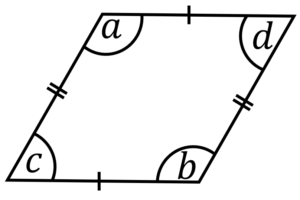
-
d = °
⌨️ Enter your answer in the field provided.
CorrectIncorrectHint
💡 Parallelogram angles: copy the diagram, use the markings to set equal angles, then use angles on a straight line (180°) or around the shape (360°) to find the missing one.
First copy the parallelogram and label the given angle and the matching equal angle using the markings.
Use the fact that in a parallelogram opposite angles are equal and neighbouring angles add to 180°.
If the diagram shows pairs like a = b and c = d, write those down first, then use 360° for a full quadrilateral or 180° for a straight line to finish.
parallelogram facts: opposite angles are equal
neighbouring angles add to 180°
angles in any quadrilateral total 360°
use markings: a = b and c = d (if shown)
then: a + b + c + d = 360°
so: c + d = 360° − a − b
since c = d: d = (360° − a − b) ÷ 2
-
-
Question 3 of 50
3. Question
Topic: Angles in Quadrilaterals.
Please have pen and paper handy to show workings out. 📝
📐 In the diagram (not to scale), .
Calculate the size of angle .
-
b = °
⌨️ Enter your answer in the field provided.
CorrectIncorrectHint
💡 Parallelogram angles: copy the diagram, use the markings to set equal angles, then use angles on a straight line (180°) or around the shape (360°) to find the missing one.
First copy the parallelogram and label the given angle and the matching equal angle using the markings.
Use the fact that in a parallelogram opposite angles are equal and neighbouring angles add to 180°.
If the diagram shows pairs like a = b and c = d, write those down first, then use 360° for a full quadrilateral or 180° for a straight line to finish.
parallelogram facts: opposite angles are equal
neighbouring angles add to 180°
angles in any quadrilateral total 360°
use markings: a = b and c = d (if shown)
then: a + b + c + d = 360°
so: c + d = 360° − a − b
since c = d: d = (360° − a − b) ÷ 2
-
-
Question 4 of 50
4. Question
Topic: Angles in Quadrilaterals.
Please have pen and paper handy to show workings out. 📝
📐 In the diagram (not to scale), the shape has one line of symmetry, .
Calculate the size of angle .

-
c = °
⌨️ Enter your answer in the field provided.
CorrectIncorrectHint
💡 Trapezium with one line of symmetry: copy the diagram, use the symmetry line to match equal angles, then use the 360° total in a quadrilateral to find the missing one.
First copy the trapezium and label the given angle and the matching equal angle using the line of symmetry.
Use the symmetry to write the equal pairs, like c = b and a = d, because mirrored corners match.
Then use 360° for the full quadrilateral to build one equation and solve for the missing angle.
symmetry facts: mirrored angles are equal
so: c = b and a = d
angles in any quadrilateral total 360°
then: a + b + c + d = 360°
substitute: a + b + b + a = 360°
so: 2a + 2b = 360°
so: 2a = 360° − 2b
then: a = (360° − 2b) ÷ 2
-
-
Question 5 of 50
5. Question
Topic: Angles in Quadrilaterals.
Please have pen and paper handy to show workings out. 📝
📐 In the diagram (not to scale), .
Calculate the size of angle .
-
c = °
⌨️ Enter your answer in the field provided.
CorrectIncorrectHint
💡 Symmetry rhombus angles: copy the diagram, use the symmetry marks to set equal angles, then use the 360° rule to share out the remaining angle.
First copy the rhombus and label the given angle a, the matching angle b, and the two unknown angles c and d.
Spot it is a rhombus because all four sides are equal and it is still a quadrilateral so the angles total 360°.
Use the symmetry marks to say a = b and c = d, then subtract the two known angles from 360° and split what is left between c and d.
angles in a quadrilateral total 360°
use symmetry: a = b and c = d
angle total: a + b + c + d = 360°
so: c + d = 360° − a − b
since c = d: c = (360° − a − b) ÷ 2
-
-
Question 6 of 50
6. Question
Topic: Angles in Quadrilaterals.
Please have pen and paper handy to show workings out. 📝
📐 In the diagram (not to scale), .
Calculate the size of angle .
-
d = °
⌨️ Enter your answer in the field provided.
CorrectIncorrectHint
💡 Parallelogram angles: copy the diagram, use the markings to set equal angles, then use angles on a straight line (180°) or around the shape (360°) to find the missing one.
First copy the parallelogram and label the given angle and the matching equal angle using the markings.
Use the fact that in a parallelogram opposite angles are equal and neighbouring angles add to 180°.
If the diagram shows pairs like a = b and c = d, write those down first, then use 360° for a full quadrilateral or 180° for a straight line to finish.
parallelogram facts: opposite angles are equal
neighbouring angles add to 180°
angles in any quadrilateral total 360°
use markings: a = b and c = d (if shown)
then: a + b + c + d = 360°
so: c + d = 360° − a − b
since c = d: d = (360° − a − b) ÷ 2
-
-
Question 7 of 50
7. Question
Topic: Angles in Quadrilaterals.
Please have pen and paper handy to show workings out. 📝
📐 In the diagram (not to scale), the shape has one line of symmetry, .
Calculate the size of angle .
-
a = °
⌨️ Enter your answer in the field provided.
CorrectIncorrectHint
💡 Trapezium with one line of symmetry: copy the diagram, use the symmetry line to match equal angles, then use the 360° total in a quadrilateral to find the missing one.
First copy the trapezium and label the given angle and the matching equal angle using the line of symmetry.
Use the symmetry to write the equal pairs, like c = b and a = d, because mirrored corners match.
Then use 360° for the full quadrilateral to build one equation and solve for the missing angle.
symmetry facts: mirrored angles are equal
so: c = b and a = d
angles in any quadrilateral total 360°
then: a + b + c + d = 360°
substitute: a + b + b + a = 360°
so: 2a + 2b = 360°
so: 2a = 360° − 2b
then: a = (360° − 2b) ÷ 2
-
-
Question 8 of 50
8. Question
Topic: Angles in Quadrilaterals.
Please have pen and paper handy to show workings out. 📝
📐 In the diagram (not to scale), .
Calculate the size of angle .
-
c = °
⌨️ Enter your answer in the field provided.
CorrectIncorrectHint
💡 Symmetry rhombus angles: copy the diagram, use the symmetry marks to set equal angles, then use the 360° rule to share out the remaining angle.
First copy the rhombus and label the given angle a, the matching angle b, and the two unknown angles c and d.
Spot it is a rhombus because all four sides are equal and it is still a quadrilateral so the angles total 360°.
Use the symmetry marks to say a = b and c = d, then subtract the two known angles from 360° and split what is left between c and d.
angles in a quadrilateral total 360°
use symmetry: a = b and c = d
angle total: a + b + c + d = 360°
so: c + d = 360° − a − b
since c = d: c = (360° − a − b) ÷ 2
-
-
Question 9 of 50
9. Question
Topic: Angles in Quadrilaterals.
Please have pen and paper handy to show workings out. 📝
📐 In the diagram (not to scale), .
Calculate the size of angle .
-
d = °
⌨️ Enter your answer in the field provided.
CorrectIncorrectHint
💡 Parallelogram angles: copy the diagram, use the markings to set equal angles, then use angles on a straight line (180°) or around the shape (360°) to find the missing one.
First copy the parallelogram and label the given angle and the matching equal angle using the markings.
Use the fact that in a parallelogram opposite angles are equal and neighbouring angles add to 180°.
If the diagram shows pairs like a = b and c = d, write those down first, then use 360° for a full quadrilateral or 180° for a straight line to finish.
parallelogram facts: opposite angles are equal
neighbouring angles add to 180°
angles in any quadrilateral total 360°
use markings: a = b and c = d (if shown)
then: a + b + c + d = 360°
so: c + d = 360° − a − b
since c = d: d = (360° − a − b) ÷ 2
-
-
Question 10 of 50
10. Question
Topic: Angles in Quadrilaterals.
Please have pen and paper handy to show workings out. 📝
📐 In the diagram (not to scale), the shape has one line of symmetry, .
Calculate the size of angle .
-
a = °
⌨️ Enter your answer in the field provided.
CorrectIncorrectHint
💡 Trapezium with one line of symmetry: copy the diagram, use the symmetry line to match equal angles, then use the 360° total in a quadrilateral to find the missing one.
First copy the trapezium and label the given angle and the matching equal angle using the line of symmetry.
Use the symmetry to write the equal pairs, like c = b and a = d, because mirrored corners match.
Then use 360° for the full quadrilateral to build one equation and solve for the missing angle.
symmetry facts: mirrored angles are equal
so: c = b and a = d
angles in any quadrilateral total 360°
then: a + b + c + d = 360°
substitute: a + b + b + a = 360°
so: 2a + 2b = 360°
so: 2a = 360° − 2b
then: a = (360° − 2b) ÷ 2
-
-
Question 11 of 50
11. Question
Topic: Angles in Quadrilaterals.
Please have pen and paper handy to show workings out. 📝
📐 In the diagram (not to scale), .
Calculate the size of angle .
-
c = °
⌨️ Enter your answer in the field provided.
CorrectIncorrectHint
💡 Symmetry rhombus angles: copy the diagram, use the symmetry marks to set equal angles, then use the 360° rule to share out the remaining angle.
First copy the rhombus and label the given angle a, the matching angle b, and the two unknown angles c and d.
Spot it is a rhombus because all four sides are equal and it is still a quadrilateral so the angles total 360°.
Use the symmetry marks to say a = b and c = d, then subtract the two known angles from 360° and split what is left between c and d.
angles in a quadrilateral total 360°
use symmetry: a = b and c = d
angle total: a + b + c + d = 360°
so: c + d = 360° − a − b
since c = d: c = (360° − a − b) ÷ 2
-
-
Question 12 of 50
12. Question
Topic: Angles in Quadrilaterals.
Please have pen and paper handy to show workings out. 📝
📐 In the diagram (not to scale), .
Calculate the size of angle .
-
d = °
⌨️ Enter your answer in the field provided.
CorrectIncorrectHint
💡 Parallelogram angles: copy the diagram, use the markings to set equal angles, then use angles on a straight line (180°) or around the shape (360°) to find the missing one.
First copy the parallelogram and label the given angle and the matching equal angle using the markings.
Use the fact that in a parallelogram opposite angles are equal and neighbouring angles add to 180°.
If the diagram shows pairs like a = b and c = d, write those down first, then use 360° for a full quadrilateral or 180° for a straight line to finish.
parallelogram facts: opposite angles are equal
neighbouring angles add to 180°
angles in any quadrilateral total 360°
use markings: a = b and c = d (if shown)
then: a + b + c + d = 360°
so: c + d = 360° − a − b
since c = d: d = (360° − a − b) ÷ 2
-
-
Question 13 of 50
13. Question
Topic: Angles in Quadrilaterals.
Please have pen and paper handy to show workings out. 📝
📐 In the diagram (not to scale), the shape has one line of symmetry, .
Calculate the size of angle .
-
a = °
⌨️ Enter your answer in the field provided.
CorrectIncorrectHint
💡 Trapezium with one line of symmetry: copy the diagram, use the symmetry line to match equal angles, then use the 360° total in a quadrilateral to find the missing one.
First copy the trapezium and label the given angle and the matching equal angle using the line of symmetry.
Use the symmetry to write the equal pairs, like c = b and a = d, because mirrored corners match.
Then use 360° for the full quadrilateral to build one equation and solve for the missing angle.
symmetry facts: mirrored angles are equal
so: c = b and a = d
angles in any quadrilateral total 360°
then: a + b + c + d = 360°
substitute: a + b + b + a = 360°
so: 2a + 2b = 360°
so: 2a = 360° − 2b
then: a = (360° − 2b) ÷ 2
-
-
Question 14 of 50
14. Question
Topic: Angles in Quadrilaterals.
Please have pen and paper handy to show workings out. 📝
📐 In the diagram (not to scale), .
Calculate the size of angle .
-
c = °
⌨️ Enter your answer in the field provided.
CorrectIncorrectHint
💡 Symmetry rhombus angles: copy the diagram, use the symmetry marks to set equal angles, then use the 360° rule to share out the remaining angle.
First copy the rhombus and label the given angle a, the matching angle b, and the two unknown angles c and d.
Spot it is a rhombus because all four sides are equal and it is still a quadrilateral so the angles total 360°.
Use the symmetry marks to say a = b and c = d, then subtract the two known angles from 360° and split what is left between c and d.
angles in a quadrilateral total 360°
use symmetry: a = b and c = d
angle total: a + b + c + d = 360°
so: c + d = 360° − a − b
since c = d: c = (360° − a − b) ÷ 2
-
-
Question 15 of 50
15. Question
Topic: Angles in Quadrilaterals.
Please have pen and paper handy to show workings out. 📝
📐 In the diagram (not to scale), .
Calculate the size of angle .
-
d = °
⌨️ Enter your answer in the field provided.
CorrectIncorrectHint
💡 Parallelogram angles: copy the diagram, use the markings to set equal angles, then use angles on a straight line (180°) or around the shape (360°) to find the missing one.
First copy the parallelogram and label the given angle and the matching equal angle using the markings.
Use the fact that in a parallelogram opposite angles are equal and neighbouring angles add to 180°.
If the diagram shows pairs like a = b and c = d, write those down first, then use 360° for a full quadrilateral or 180° for a straight line to finish.
parallelogram facts: opposite angles are equal
neighbouring angles add to 180°
angles in any quadrilateral total 360°
use markings: a = b and c = d (if shown)
then: a + b + c + d = 360°
so: c + d = 360° − a − b
since c = d: d = (360° − a − b) ÷ 2
-
-
Question 16 of 50
16. Question
Topic: Angles in Quadrilaterals.
Please have pen and paper handy to show workings out. 📝
📐 In the diagram (not to scale), the shape has one line of symmetry, .
Calculate the size of angle .
-
a = °
⌨️ Enter your answer in the field provided.
CorrectIncorrectHint
💡 Trapezium with one line of symmetry: copy the diagram, use the symmetry line to match equal angles, then use the 360° total in a quadrilateral to find the missing one.
First copy the trapezium and label the given angle and the matching equal angle using the line of symmetry.
Use the symmetry to write the equal pairs, like c = b and a = d, because mirrored corners match.
Then use 360° for the full quadrilateral to build one equation and solve for the missing angle.
symmetry facts: mirrored angles are equal
so: c = b and a = d
angles in any quadrilateral total 360°
then: a + b + c + d = 360°
substitute: a + b + b + a = 360°
so: 2a + 2b = 360°
so: 2a = 360° − 2b
then: a = (360° − 2b) ÷ 2
-
-
Question 17 of 50
17. Question
Topic: Angles in Quadrilaterals.
Please have pen and paper handy to show workings out. 📝
📐 In the diagram (not to scale), .
Calculate the size of angle .
-
c = °
⌨️ Enter your answer in the field provided.
CorrectIncorrectHint
💡 Symmetry rhombus angles: copy the diagram, use the symmetry marks to set equal angles, then use the 360° rule to share out the remaining angle.
First copy the rhombus and label the given angle a, the matching angle b, and the two unknown angles c and d.
Spot it is a rhombus because all four sides are equal and it is still a quadrilateral so the angles total 360°.
Use the symmetry marks to say a = b and c = d, then subtract the two known angles from 360° and split what is left between c and d.
angles in a quadrilateral total 360°
use symmetry: a = b and c = d
angle total: a + b + c + d = 360°
so: c + d = 360° − a − b
since c = d: c = (360° − a − b) ÷ 2
-
-
Question 18 of 50
18. Question
Topic: Angles in Quadrilaterals.
Please have pen and paper handy to show workings out. 📝
📐 In the diagram (not to scale), .
Calculate the size of angle .
-
d = °
⌨️ Enter your answer in the field provided.
CorrectIncorrectHint
💡 Parallelogram angles: copy the diagram, use the markings to set equal angles, then use angles on a straight line (180°) or around the shape (360°) to find the missing one.
First copy the parallelogram and label the given angle and the matching equal angle using the markings.
Use the fact that in a parallelogram opposite angles are equal and neighbouring angles add to 180°.
If the diagram shows pairs like a = b and c = d, write those down first, then use 360° for a full quadrilateral or 180° for a straight line to finish.
parallelogram facts: opposite angles are equal
neighbouring angles add to 180°
angles in any quadrilateral total 360°
use markings: a = b and c = d (if shown)
then: a + b + c + d = 360°
so: c + d = 360° − a − b
since c = d: d = (360° − a − b) ÷ 2
-
-
Question 19 of 50
19. Question
Topic: Angles in Quadrilaterals.
Please have pen and paper handy to show workings out. 📝
📐 In the diagram (not to scale), the shape has one line of symmetry, .
Calculate the size of angle .
-
a = °
⌨️ Enter your answer in the field provided.
CorrectIncorrectHint
💡 Trapezium with one line of symmetry: copy the diagram, use the symmetry line to match equal angles, then use the 360° total in a quadrilateral to find the missing one.
First copy the trapezium and label the given angle and the matching equal angle using the line of symmetry.
Use the symmetry to write the equal pairs, like c = b and a = d, because mirrored corners match.
Then use 360° for the full quadrilateral to build one equation and solve for the missing angle.
symmetry facts: mirrored angles are equal
so: c = b and a = d
angles in any quadrilateral total 360°
then: a + b + c + d = 360°
substitute: a + b + b + a = 360°
so: 2a + 2b = 360°
so: 2a = 360° − 2b
then: a = (360° − 2b) ÷ 2
-
-
Question 20 of 50
20. Question
Topic: Angles in Quadrilaterals.
Please have pen and paper handy to show workings out. 📝
📐 In the diagram (not to scale), .
Calculate the size of angle .
-
c = °
⌨️ Enter your answer in the field provided.
CorrectIncorrectHint
💡 Symmetry rhombus angles: copy the diagram, use the symmetry marks to set equal angles, then use the 360° rule to share out the remaining angle.
First copy the rhombus and label the given angle a, the matching angle b, and the two unknown angles c and d.
Spot it is a rhombus because all four sides are equal and it is still a quadrilateral so the angles total 360°.
Use the symmetry marks to say a = b and c = d, then subtract the two known angles from 360° and split what is left between c and d.
angles in a quadrilateral total 360°
use symmetry: a = b and c = d
angle total: a + b + c + d = 360°
so: c + d = 360° − a − b
since c = d: c = (360° − a − b) ÷ 2
-
-
Question 21 of 50
21. Question
Topic: Angles in Quadrilaterals.
Please have pen and paper handy to show workings out. 📝
📐 In the diagram (not to scale), .
Calculate the size of angle .
-
d = °
⌨️ Enter your answer in the field provided.
CorrectIncorrectHint
💡 Parallelogram angles: copy the diagram, use the markings to set equal angles, then use angles on a straight line (180°) or around the shape (360°) to find the missing one.
First copy the parallelogram and label the given angle and the matching equal angle using the markings.
Use the fact that in a parallelogram opposite angles are equal and neighbouring angles add to 180°.
If the diagram shows pairs like a = b and c = d, write those down first, then use 360° for a full quadrilateral or 180° for a straight line to finish.
parallelogram facts: opposite angles are equal
neighbouring angles add to 180°
angles in any quadrilateral total 360°
use markings: a = b and c = d (if shown)
then: a + b + c + d = 360°
so: c + d = 360° − a − b
since c = d: d = (360° − a − b) ÷ 2
-
-
Question 22 of 50
22. Question
Topic: Angles in Quadrilaterals.
Please have pen and paper handy to show workings out. 📝
📐 In the diagram (not to scale), the shape has one line of symmetry, .
Calculate the size of angle .
-
a = °
⌨️ Enter your answer in the field provided.
CorrectIncorrectHint
💡 Trapezium with one line of symmetry: copy the diagram, use the symmetry line to match equal angles, then use the 360° total in a quadrilateral to find the missing one.
First copy the trapezium and label the given angle and the matching equal angle using the line of symmetry.
Use the symmetry to write the equal pairs, like c = b and a = d, because mirrored corners match.
Then use 360° for the full quadrilateral to build one equation and solve for the missing angle.
symmetry facts: mirrored angles are equal
so: c = b and a = d
angles in any quadrilateral total 360°
then: a + b + c + d = 360°
substitute: a + b + b + a = 360°
so: 2a + 2b = 360°
so: 2a = 360° − 2b
then: a = (360° − 2b) ÷ 2
-
-
Question 23 of 50
23. Question
Topic: Angles in Quadrilaterals.
Please have pen and paper handy to show workings out. 📝
📐 In the diagram (not to scale), .
Calculate the size of angle .
-
c = °
⌨️ Enter your answer in the field provided.
CorrectIncorrectHint
💡 Symmetry rhombus angles: copy the diagram, use the symmetry marks to set equal angles, then use the 360° rule to share out the remaining angle.
First copy the rhombus and label the given angle a, the matching angle b, and the two unknown angles c and d.
Spot it is a rhombus because all four sides are equal and it is still a quadrilateral so the angles total 360°.
Use the symmetry marks to say a = b and c = d, then subtract the two known angles from 360° and split what is left between c and d.
angles in a quadrilateral total 360°
use symmetry: a = b and c = d
angle total: a + b + c + d = 360°
so: c + d = 360° − a − b
since c = d: c = (360° − a − b) ÷ 2
-
-
Question 24 of 50
24. Question
Topic: Angles in Quadrilaterals.
Please have pen and paper handy to show workings out. 📝
📐 In the diagram (not to scale), .
Calculate the size of angle .
-
d = °
⌨️ Enter your answer in the field provided.
CorrectIncorrectHint
💡 Parallelogram angles: copy the diagram, use the markings to set equal angles, then use angles on a straight line (180°) or around the shape (360°) to find the missing one.
First copy the parallelogram and label the given angle and the matching equal angle using the markings.
Use the fact that in a parallelogram opposite angles are equal and neighbouring angles add to 180°.
If the diagram shows pairs like a = b and c = d, write those down first, then use 360° for a full quadrilateral or 180° for a straight line to finish.
parallelogram facts: opposite angles are equal
neighbouring angles add to 180°
angles in any quadrilateral total 360°
use markings: a = b and c = d (if shown)
then: a + b + c + d = 360°
so: c + d = 360° − a − b
since c = d: d = (360° − a − b) ÷ 2
-
-
Question 25 of 50
25. Question
Topic: Angles in Quadrilaterals.
Please have pen and paper handy to show workings out. 📝
📐 In the diagram (not to scale), the shape has one line of symmetry, .
Calculate the size of angle .
-
a = °
⌨️ Enter your answer in the field provided.
CorrectIncorrectHint
💡 Trapezium with one line of symmetry: copy the diagram, use the symmetry line to match equal angles, then use the 360° total in a quadrilateral to find the missing one.
First copy the trapezium and label the given angle and the matching equal angle using the line of symmetry.
Use the symmetry to write the equal pairs, like c = b and a = d, because mirrored corners match.
Then use 360° for the full quadrilateral to build one equation and solve for the missing angle.
symmetry facts: mirrored angles are equal
so: c = b and a = d
angles in any quadrilateral total 360°
then: a + b + c + d = 360°
substitute: a + b + b + a = 360°
so: 2a + 2b = 360°
so: 2a = 360° − 2b
then: a = (360° − 2b) ÷ 2
-
-
Question 26 of 50
26. Question
Topic: Angles in Quadrilaterals.
Please have pen and paper handy to show workings out. 📝
📐 In the diagram (not to scale), .
Calculate the size of angle .
-
c = °
⌨️ Enter your answer in the field provided.
CorrectIncorrectHint
💡 Symmetry rhombus angles: copy the diagram, use the symmetry marks to set equal angles, then use the 360° rule to share out the remaining angle.
First copy the rhombus and label the given angle a, the matching angle b, and the two unknown angles c and d.
Spot it is a rhombus because all four sides are equal and it is still a quadrilateral so the angles total 360°.
Use the symmetry marks to say a = b and c = d, then subtract the two known angles from 360° and split what is left between c and d.
angles in a quadrilateral total 360°
use symmetry: a = b and c = d
angle total: a + b + c + d = 360°
so: c + d = 360° − a − b
since c = d: c = (360° − a − b) ÷ 2
Don’t include this line!
Don’t include this line!
-
-
Question 27 of 50
27. Question
Topic: Angles in Quadrilaterals.
Please have pen and paper handy to show workings out. 📝
📐 In the diagram (not to scale), .
Calculate the size of angle .
-
d = °
⌨️ Enter your answer in the field provided.
CorrectIncorrectHint
💡 Parallelogram angles: copy the diagram, use the markings to set equal angles, then use angles on a straight line (180°) or around the shape (360°) to find the missing one.
First copy the parallelogram and label the given angle and the matching equal angle using the markings.
Use the fact that in a parallelogram opposite angles are equal and neighbouring angles add to 180°.
If the diagram shows pairs like a = b and c = d, write those down first, then use 360° for a full quadrilateral or 180° for a straight line to finish.
parallelogram facts: opposite angles are equal
neighbouring angles add to 180°
angles in any quadrilateral total 360°
use markings: a = b and c = d (if shown)
then: a + b + c + d = 360°
so: c + d = 360° − a − b
since c = d: d = (360° − a − b) ÷ 2
-
-
Question 28 of 50
28. Question
Topic: Angles in Quadrilaterals.
Please have pen and paper handy to show workings out. 📝
📐 In the diagram (not to scale), the shape has one line of symmetry, .
Calculate the size of angle .
-
a = °
⌨️ Enter your answer in the field provided.
CorrectIncorrectHint
💡 Trapezium with one line of symmetry: copy the diagram, use the symmetry line to match equal angles, then use the 360° total in a quadrilateral to find the missing one.
First copy the trapezium and label the given angle and the matching equal angle using the line of symmetry.
Use the symmetry to write the equal pairs, like c = b and a = d, because mirrored corners match.
Then use 360° for the full quadrilateral to build one equation and solve for the missing angle.
symmetry facts: mirrored angles are equal
so: c = b and a = d
angles in any quadrilateral total 360°
then: a + b + c + d = 360°
substitute: a + b + b + a = 360°
so: 2a + 2b = 360°
so: 2a = 360° − 2b
then: a = (360° − 2b) ÷ 2
-
-
Question 29 of 50
29. Question
Topic: Angles in Quadrilaterals.
Please have pen and paper handy to show workings out. 📝
📐 In the diagram (not to scale), .
Calculate the size of angle .
-
b = °
⌨️ Enter your answer in the field provided.
CorrectIncorrectHint
💡 Symmetry rhombus angles: copy the diagram, use the symmetry marks to set equal angles, then use the 360° rule to share out the remaining angle.
First copy the rhombus and label the given angle a, the matching angle b, and the two unknown angles c and d.
Spot it is a rhombus because all four sides are equal and it is still a quadrilateral so the angles total 360°.
Use the symmetry marks to say a = b and c = d, then subtract the two known angles from 360° and split what is left between c and d.
angles in a quadrilateral total 360°
use symmetry: a = b and c = d
angle total: a + b + c + d = 360°
so: c + d = 360° − a − b
since c = d: c = (360° − a − b) ÷ 2
-
-
Question 30 of 50
30. Question
Topic: Angles in Quadrilaterals.
Please have pen and paper handy to show workings out. 📝
📐 In the diagram (not to scale), .
Calculate the size of angle .
-
d = °
⌨️ Enter your answer in the field provided.
CorrectIncorrectHint
💡 Parallelogram angles: copy the diagram, use the markings to set equal angles, then use angles on a straight line (180°) or around the shape (360°) to find the missing one.
First copy the parallelogram and label the given angle and the matching equal angle using the markings.
Use the fact that in a parallelogram opposite angles are equal and neighbouring angles add to 180°.
If the diagram shows pairs like a = b and c = d, write those down first, then use 360° for a full quadrilateral or 180° for a straight line to finish.
parallelogram facts: opposite angles are equal
neighbouring angles add to 180°
angles in any quadrilateral total 360°
use markings: a = b and c = d (if shown)
then: a + b + c + d = 360°
so: c + d = 360° − a − b
since c = d: d = (360° − a − b) ÷ 2
-
-
Question 31 of 50
31. Question
Topic: Angles in Quadrilaterals.
Please have pen and paper handy to show workings out. 📝
📐 In the diagram (not to scale), the shape has one line of symmetry, .
Calculate the size of angle .
-
c = °
⌨️ Enter your answer in the field provided.
CorrectIncorrectHint
💡 Trapezium with one line of symmetry: copy the diagram, use the symmetry line to match equal angles, then use the 360° total in a quadrilateral to find the missing one.
First copy the trapezium and label the given angle and the matching equal angle using the line of symmetry.
Use the symmetry to write the equal pairs, like c = b and a = d, because mirrored corners match.
Then use 360° for the full quadrilateral to build one equation and solve for the missing angle.
symmetry facts: mirrored angles are equal
so: c = b and a = d
angles in any quadrilateral total 360°
then: a + b + c + d = 360°
substitute: a + b + b + a = 360°
so: 2a + 2b = 360°
so: 2a = 360° − 2b
then: a = (360° − 2b) ÷ 2
-
-
Question 32 of 50
32. Question
Topic: Angles in Quadrilaterals.
Please have pen and paper handy to show workings out. 📝
📐 In the diagram (not to scale), .
Calculate the size of angle .
-
b = °
⌨️ Enter your answer in the field provided.
CorrectIncorrectHint
💡 Symmetry rhombus angles: copy the diagram, use the symmetry marks to set equal angles, then use the 360° rule to share out the remaining angle.
First copy the rhombus and label the given angle a, the matching angle b, and the two unknown angles c and d.
Spot it is a rhombus because all four sides are equal and it is still a quadrilateral so the angles total 360°.
Use the symmetry marks to say a = b and c = d, then subtract the two known angles from 360° and split what is left between c and d.
angles in a quadrilateral total 360°
use symmetry: a = b and c = d
angle total: a + b + c + d = 360°
so: c + d = 360° − a − b
since c = d: c = (360° − a − b) ÷ 2
-
-
Question 33 of 50
33. Question
Topic: Angles in Quadrilaterals.
Please have pen and paper handy to show workings out. 📝
📐 In the diagram (not to scale), .
Calculate the size of angle .
-
b = °
⌨️ Enter your answer in the field provided.
CorrectIncorrectHint
💡 Parallelogram angles: copy the diagram, use the markings to set equal angles, then use angles on a straight line (180°) or around the shape (360°) to find the missing one.
First copy the parallelogram and label the given angle and the matching equal angle using the markings.
Use the fact that in a parallelogram opposite angles are equal and neighbouring angles add to 180°.
If the diagram shows pairs like a = b and c = d, write those down first, then use 360° for a full quadrilateral or 180° for a straight line to finish.
parallelogram facts: opposite angles are equal
neighbouring angles add to 180°
angles in any quadrilateral total 360°
use markings: a = b and c = d (if shown)
then: a + b + c + d = 360°
so: c + d = 360° − a − b
since c = d: d = (360° − a − b) ÷ 2
-
-
Question 34 of 50
34. Question
Topic: Angles in Quadrilaterals.
Please have pen and paper handy to show workings out. 📝
📐 In the diagram (not to scale), the shape has one line of symmetry, .
Calculate the size of angle .
-
c = °
⌨️ Enter your answer in the field provided.
CorrectIncorrectHint
💡 Trapezium with one line of symmetry: copy the diagram, use the symmetry line to match equal angles, then use the 360° total in a quadrilateral to find the missing one.
First copy the trapezium and label the given angle and the matching equal angle using the line of symmetry.
Use the symmetry to write the equal pairs, like c = b and a = d, because mirrored corners match.
Then use 360° for the full quadrilateral to build one equation and solve for the missing angle.
symmetry facts: mirrored angles are equal
so: c = b and a = d
angles in any quadrilateral total 360°
then: a + b + c + d = 360°
substitute: a + b + b + a = 360°
so: 2a + 2b = 360°
so: 2a = 360° − 2b
then: a = (360° − 2b) ÷ 2
-
-
Question 35 of 50
35. Question
Topic: Angles in Quadrilaterals.
Please have pen and paper handy to show workings out. 📝
📐 In the diagram (not to scale), .
Calculate the size of angle .
-
b = °
⌨️ Enter your answer in the field provided.
CorrectIncorrectHint
💡 Symmetry rhombus angles: copy the diagram, use the symmetry marks to set equal angles, then use the 360° rule to share out the remaining angle.
First copy the rhombus and label the given angle a, the matching angle b, and the two unknown angles c and d.
Spot it is a rhombus because all four sides are equal and it is still a quadrilateral so the angles total 360°.
Use the symmetry marks to say a = b and c = d, then subtract the two known angles from 360° and split what is left between c and d.
angles in a quadrilateral total 360°
use symmetry: a = b and c = d
angle total: a + b + c + d = 360°
so: c + d = 360° − a − b
since c = d: c = (360° − a − b) ÷ 2
-
-
Question 36 of 50
36. Question
Topic: Angles in Quadrilaterals.
Please have pen and paper handy to show workings out. 📝
📐 In the diagram (not to scale), .
Calculate the size of angle .
-
b = °
⌨️ Enter your answer in the field provided.
CorrectIncorrectHint
💡 Parallelogram angles: copy the diagram, use the markings to set equal angles, then use angles on a straight line (180°) or around the shape (360°) to find the missing one.
First copy the parallelogram and label the given angle and the matching equal angle using the markings.
Use the fact that in a parallelogram opposite angles are equal and neighbouring angles add to 180°.
If the diagram shows pairs like a = b and c = d, write those down first, then use 360° for a full quadrilateral or 180° for a straight line to finish.
parallelogram facts: opposite angles are equal
neighbouring angles add to 180°
angles in any quadrilateral total 360°
use markings: a = b and c = d (if shown)
then: a + b + c + d = 360°
so: c + d = 360° − a − b
since c = d: d = (360° − a − b) ÷ 2
-
-
Question 37 of 50
37. Question
Topic: Angles in Quadrilaterals.
Please have pen and paper handy to show workings out. 📝
📐 In the diagram (not to scale), the shape has one line of symmetry, .
Calculate the size of angle .
-
c = °
⌨️ Enter your answer in the field provided.
CorrectIncorrectHint
💡 Trapezium with one line of symmetry: copy the diagram, use the symmetry line to match equal angles, then use the 360° total in a quadrilateral to find the missing one.
First copy the trapezium and label the given angle and the matching equal angle using the line of symmetry.
Use the symmetry to write the equal pairs, like c = b and a = d, because mirrored corners match.
Then use 360° for the full quadrilateral to build one equation and solve for the missing angle.
symmetry facts: mirrored angles are equal
so: c = b and a = d
angles in any quadrilateral total 360°
then: a + b + c + d = 360°
substitute: a + b + b + a = 360°
so: 2a + 2b = 360°
so: 2a = 360° − 2b
then: a = (360° − 2b) ÷ 2
-
-
Question 38 of 50
38. Question
Topic: Angles in Quadrilaterals.
Please have pen and paper handy to show workings out. 📝
📐 In the diagram (not to scale), .
Calculate the size of angle .
-
b = °
⌨️ Enter your answer in the field provided.
CorrectIncorrectHint
💡 Symmetry rhombus angles: copy the diagram, use the symmetry marks to set equal angles, then use the 360° rule to share out the remaining angle.
First copy the rhombus and label the given angle a, the matching angle b, and the two unknown angles c and d.
Spot it is a rhombus because all four sides are equal and it is still a quadrilateral so the angles total 360°.
Use the symmetry marks to say a = b and c = d, then subtract the two known angles from 360° and split what is left between c and d.
angles in a quadrilateral total 360°
use symmetry: a = b and c = d
angle total: a + b + c + d = 360°
so: c + d = 360° − a − b
since c = d: c = (360° − a − b) ÷ 2
-
-
Question 39 of 50
39. Question
Topic: Angles in Quadrilaterals.
Please have pen and paper handy to show workings out. 📝
📐 In the diagram (not to scale), .
Calculate the size of angle .
-
b = °
⌨️ Enter your answer in the field provided.
CorrectIncorrectHint
💡 Parallelogram angles: copy the diagram, use the markings to set equal angles, then use angles on a straight line (180°) or around the shape (360°) to find the missing one.
First copy the parallelogram and label the given angle and the matching equal angle using the markings.
Use the fact that in a parallelogram opposite angles are equal and neighbouring angles add to 180°.
If the diagram shows pairs like a = b and c = d, write those down first, then use 360° for a full quadrilateral or 180° for a straight line to finish.
parallelogram facts: opposite angles are equal
neighbouring angles add to 180°
angles in any quadrilateral total 360°
use markings: a = b and c = d (if shown)
then: a + b + c + d = 360°
so: c + d = 360° − a − b
since c = d: d = (360° − a − b) ÷ 2
-
-
Question 40 of 50
40. Question
Topic: Angles in Quadrilaterals.
Please have pen and paper handy to show workings out. 📝
📐 In the diagram (not to scale), the shape has one line of symmetry, .
Calculate the size of angle .
-
c = °
⌨️ Enter your answer in the field provided.
CorrectIncorrectHint
💡 Trapezium with one line of symmetry: copy the diagram, use the symmetry line to match equal angles, then use the 360° total in a quadrilateral to find the missing one.
First copy the trapezium and label the given angle and the matching equal angle using the line of symmetry.
Use the symmetry to write the equal pairs, like c = b and a = d, because mirrored corners match.
Then use 360° for the full quadrilateral to build one equation and solve for the missing angle.
symmetry facts: mirrored angles are equal
so: c = b and a = d
angles in any quadrilateral total 360°
then: a + b + c + d = 360°
substitute: a + b + b + a = 360°
so: 2a + 2b = 360°
so: 2a = 360° − 2b
then: a = (360° − 2b) ÷ 2
-
-
Question 41 of 50
41. Question
Topic: Angles in Quadrilaterals.
Please have pen and paper handy to show workings out. 📝
📐 In the diagram (not to scale), .
Calculate the size of angle .
-
b = °
⌨️ Enter your answer in the field provided.
CorrectIncorrectHint
💡 Symmetry rhombus angles: copy the diagram, use the symmetry marks to set equal angles, then use the 360° rule to share out the remaining angle.
First copy the rhombus and label the given angle a, the matching angle b, and the two unknown angles c and d.
Spot it is a rhombus because all four sides are equal and it is still a quadrilateral so the angles total 360°.
Use the symmetry marks to say a = b and c = d, then subtract the two known angles from 360° and split what is left between c and d.
angles in a quadrilateral total 360°
use symmetry: a = b and c = d
angle total: a + b + c + d = 360°
so: c + d = 360° − a − b
since c = d: c = (360° − a − b) ÷ 2
-
-
Question 42 of 50
42. Question
Topic: Angles in Quadrilaterals.
Please have pen and paper handy to show workings out. 📝
📐 In the diagram (not to scale), .
Calculate the size of angle .
-
b = °
⌨️ Enter your answer in the field provided.
CorrectIncorrectHint
💡 Parallelogram angles: copy the diagram, use the markings to set equal angles, then use angles on a straight line (180°) or around the shape (360°) to find the missing one.
First copy the parallelogram and label the given angle and the matching equal angle using the markings.
Use the fact that in a parallelogram opposite angles are equal and neighbouring angles add to 180°.
If the diagram shows pairs like a = b and c = d, write those down first, then use 360° for a full quadrilateral or 180° for a straight line to finish.
parallelogram facts: opposite angles are equal
neighbouring angles add to 180°
angles in any quadrilateral total 360°
use markings: a = b and c = d (if shown)
then: a + b + c + d = 360°
so: c + d = 360° − a − b
since c = d: d = (360° − a − b) ÷ 2
-
-
Question 43 of 50
43. Question
Topic: Angles in Quadrilaterals.
Please have pen and paper handy to show workings out. 📝
📐 In the diagram (not to scale), the shape has one line of symmetry, .
Calculate the size of angle .
-
c = °
⌨️ Enter your answer in the field provided.
CorrectIncorrectHint
💡 Trapezium with one line of symmetry: copy the diagram, use the symmetry line to match equal angles, then use the 360° total in a quadrilateral to find the missing one.
First copy the trapezium and label the given angle and the matching equal angle using the line of symmetry.
Use the symmetry to write the equal pairs, like c = b and a = d, because mirrored corners match.
Then use 360° for the full quadrilateral to build one equation and solve for the missing angle.
symmetry facts: mirrored angles are equal
so: c = b and a = d
angles in any quadrilateral total 360°
then: a + b + c + d = 360°
substitute: a + b + b + a = 360°
so: 2a + 2b = 360°
so: 2a = 360° − 2b
then: a = (360° − 2b) ÷ 2
-
-
Question 44 of 50
44. Question
Topic: Angles in Quadrilaterals.
Please have pen and paper handy to show workings out. 📝
📐 In the diagram (not to scale), .
Calculate the size of angle .
-
b = °
⌨️ Enter your answer in the field provided.
CorrectIncorrectHint
💡 Symmetry rhombus angles: copy the diagram, use the symmetry marks to set equal angles, then use the 360° rule to share out the remaining angle.
First copy the rhombus and label the given angle a, the matching angle b, and the two unknown angles c and d.
Spot it is a rhombus because all four sides are equal and it is still a quadrilateral so the angles total 360°.
Use the symmetry marks to say a = b and c = d, then subtract the two known angles from 360° and split what is left between c and d.
angles in a quadrilateral total 360°
use symmetry: a = b and c = d
angle total: a + b + c + d = 360°
so: c + d = 360° − a − b
since c = d: c = (360° − a − b) ÷ 2
-
-
Question 45 of 50
45. Question
Topic: Angles in Quadrilaterals.
Please have pen and paper handy to show workings out. 📝
📐 In the diagram (not to scale), .
Calculate the size of angle .
-
b = °
⌨️ Enter your answer in the field provided.
CorrectIncorrectHint
💡 Parallelogram angles: copy the diagram, use the markings to set equal angles, then use angles on a straight line (180°) or around the shape (360°) to find the missing one.
First copy the parallelogram and label the given angle and the matching equal angle using the markings.
Use the fact that in a parallelogram opposite angles are equal and neighbouring angles add to 180°.
If the diagram shows pairs like a = b and c = d, write those down first, then use 360° for a full quadrilateral or 180° for a straight line to finish.
parallelogram facts: opposite angles are equal
neighbouring angles add to 180°
angles in any quadrilateral total 360°
use markings: a = b and c = d (if shown)
then: a + b + c + d = 360°
so: c + d = 360° − a − b
since c = d: d = (360° − a − b) ÷ 2
-
-
Question 46 of 50
46. Question
Topic: Angles in Quadrilaterals.
Please have pen and paper handy to show workings out. 📝
📐 In the diagram (not to scale), the shape has one line of symmetry, .
Calculate the size of angle .
-
c = °
⌨️ Enter your answer in the field provided.
CorrectIncorrectHint
💡 Trapezium with one line of symmetry: copy the diagram, use the symmetry line to match equal angles, then use the 360° total in a quadrilateral to find the missing one.
First copy the trapezium and label the given angle and the matching equal angle using the line of symmetry.
Use the symmetry to write the equal pairs, like c = b and a = d, because mirrored corners match.
Then use 360° for the full quadrilateral to build one equation and solve for the missing angle.
symmetry facts: mirrored angles are equal
so: c = b and a = d
angles in any quadrilateral total 360°
then: a + b + c + d = 360°
substitute: a + b + b + a = 360°
so: 2a + 2b = 360°
so: 2a = 360° − 2b
then: a = (360° − 2b) ÷ 2
-
-
Question 47 of 50
47. Question
Topic: Angles in Quadrilaterals.
Please have pen and paper handy to show workings out. 📝
📐 In the diagram (not to scale), .
Calculate the size of angle .
-
c = °
⌨️ Enter your answer in the field provided.
CorrectIncorrectHint
💡 Symmetry rhombus angles: copy the diagram, use the symmetry marks to set equal angles, then use the 360° rule to share out the remaining angle.
First copy the rhombus and label the given angle a, the matching angle b, and the two unknown angles c and d.
Spot it is a rhombus because all four sides are equal and it is still a quadrilateral so the angles total 360°.
Use the symmetry marks to say a = b and c = d, then subtract the two known angles from 360° and split what is left between c and d.
angles in a quadrilateral total 360°
use symmetry: a = b and c = d
angle total: a + b + c + d = 360°
so: c + d = 360° − a − b
since c = d: c = (360° − a − b) ÷ 2
-
-
Question 48 of 50
48. Question
Topic: Angles in Quadrilaterals.
Please have pen and paper handy to show workings out. 📝
📐 In the diagram (not to scale), .
Calculate the size of angle .
-
b = °
⌨️ Enter your answer in the field provided.
CorrectIncorrectHint
💡 Symmetry rhombus angles: copy the diagram, use the symmetry marks to set equal angles, then use the 360° rule to share out the remaining angle.
First copy the rhombus and label the given angle a, the matching angle b, and the two unknown angles c and d.
Spot it is a rhombus because all four sides are equal and it is still a quadrilateral so the angles total 360°.
Use the symmetry marks to say a = b and c = d, then subtract the two known angles from 360° and split what is left between c and d.
angles in a quadrilateral total 360°
use symmetry: a = b and c = d
angle total: a + b + c + d = 360°
so: c + d = 360° − a − b
since c = d: c = (360° − a − b) ÷ 2
-
-
Question 49 of 50
49. Question
Topic: Angles in Quadrilaterals.
Please have pen and paper handy to show workings out. 📝
📐 In the diagram (not to scale), .
Calculate the size of angle .
-
b = °
⌨️ Enter your answer in the field provided.
CorrectIncorrectHint
💡 Parallelogram angles: copy the diagram, use the markings to set equal angles, then use angles on a straight line (180°) or around the shape (360°) to find the missing one.
First copy the parallelogram and label the given angle and the matching equal angle using the markings.
Use the fact that in a parallelogram opposite angles are equal and neighbouring angles add to 180°.
If the diagram shows pairs like a = b and c = d, write those down first, then use 360° for a full quadrilateral or 180° for a straight line to finish.
parallelogram facts: opposite angles are equal
neighbouring angles add to 180°
angles in any quadrilateral total 360°
use markings: a = b and c = d (if shown)
then: a + b + c + d = 360°
so: c + d = 360° − a − b
since c = d: d = (360° − a − b) ÷ 2
-
-
Question 50 of 50
50. Question
Topic: Angles in Quadrilaterals.
Please have pen and paper handy to show workings out. 📝
📐 In the diagram (not to scale), the shape has one line of symmetry, .
Calculate the size of angle .
-
c = °
⌨️ Enter your answer in the field provided.
CorrectIncorrectHint
💡 Trapezium with one line of symmetry: copy the diagram, use the symmetry line to match equal angles, then use the 360° total in a quadrilateral to find the missing one.
First copy the trapezium and label the given angle and the matching equal angle using the line of symmetry.
Use the symmetry to write the equal pairs, like c = b and a = d, because mirrored corners match.
Then use 360° for the full quadrilateral to build one equation and solve for the missing angle.
symmetry facts: mirrored angles are equal
so: c = b and a = d
angles in any quadrilateral total 360°
then: a + b + c + d = 360°
substitute: a + b + b + a = 360°
so: 2a + 2b = 360°
so: 2a = 360° − 2b
then: a = (360° − 2b) ÷ 2
-