
PG.5C SEC 3, composite poly 3 (15) (20)
Quiz Summary
0 of 15 Questions completed
Questions:
Information
You have already completed the quiz before. Hence you can not start it again.
Quiz is loading…
You must sign in or sign up to start the quiz.
You must first complete the following:
Results
Results
0 of 15 Questions answered correctly
Your time:
Time has elapsed
You have reached 0 of 0 point(s), (0)
Earned Point(s): 0 of 0, (0)
0 Essay(s) Pending (Possible Point(s): 0)
Categories
- Not categorized 0%
- 1
- 2
- 3
- 4
- 5
- 6
- 7
- 8
- 9
- 10
- 11
- 12
- 13
- 14
- 15
- Current
- Review / Skip
- Answered
- Correct
- Incorrect
-
Question 1 of 15
1. Question
Topic: Polygon problems.

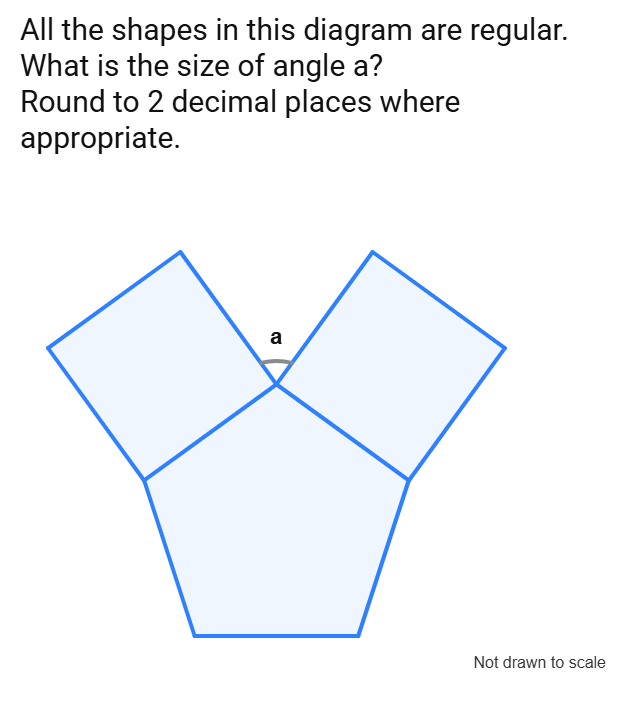
-
a = °
⌨️ Enter your answer in the field provided.
CorrectIncorrectHint
💡 Interior angles of polygons question: copy the diagram, count the sides of each regular polygon at the point, then find each interior angle and use angles around a point to get the missing angle.
Angles around a point add up to 360°.
An interior angle is the angle inside a polygon (a 2D shape with straight sides) where two sides meet.
For a regular polygon, every corner angle is the same, so you only need to find one interior angle.
Use the formula to find one interior angle when the shape has sides.
Write down the value of for each polygon before you calculate, so you do not mix them up.
Add the interior angles that meet at the point, then do to get the missing angle.
Use a calculator if you get decimals, and check your final angle is between 0° and 360°.
-
-
Question 2 of 15
2. Question
Topic: Polygon problems.
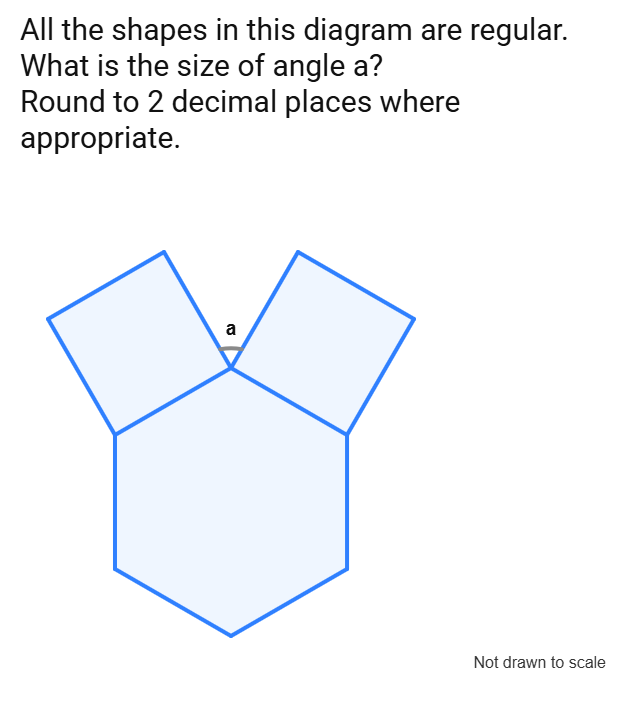
-
a = °
⌨️ Enter your answer in the field provided.
CorrectIncorrectHint
💡 Interior angles of polygons question: copy the diagram, count the sides of each regular polygon at the point, then find each interior angle and use angles around a point to get the missing angle.
Angles around a point add up to 360°.
An interior angle is the angle inside a polygon (a 2D shape with straight sides) where two sides meet.
For a regular polygon, every corner angle is the same, so you only need to find one interior angle.
Use the formula to find one interior angle when the shape has sides.
Write down the value of for each polygon before you calculate, so you do not mix them up.
Add the interior angles that meet at the point, then do to get the missing angle.
Use a calculator if you get decimals, and check your final angle is between 0° and 360°.
-
-
Question 3 of 15
3. Question
Topic: Polygon problems.
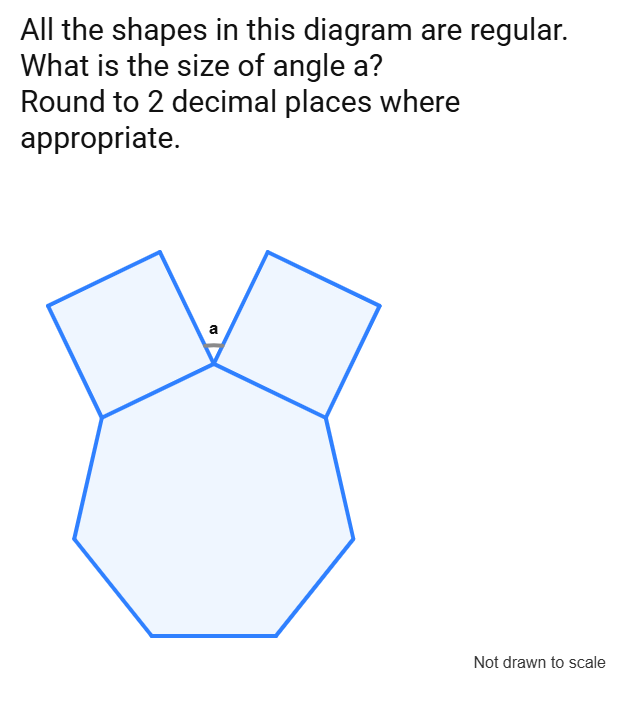
-
a = °
⌨️ Enter your answer in the field provided.
CorrectIncorrectHint
💡 Interior angles of polygons question: copy the diagram, count the sides of each regular polygon at the point, then find each interior angle and use angles around a point to get the missing angle.
Angles around a point add up to 360°.
An interior angle is the angle inside a polygon (a 2D shape with straight sides) where two sides meet.
For a regular polygon, every corner angle is the same, so you only need to find one interior angle.
Use the formula to find one interior angle when the shape has sides.
Write down the value of for each polygon before you calculate, so you do not mix them up.
Add the interior angles that meet at the point, then do to get the missing angle.
Use a calculator if you get decimals, and check your final angle is between 0° and 360°.
-
-
Question 4 of 15
4. Question
Topic: Polygon problems.

-
a = °
⌨️ Enter your answer in the field provided.
CorrectIncorrectHint
💡 Interior angles of polygons question: copy the diagram, count the sides of each regular polygon at the point, then find each interior angle and use angles around a point to get the missing angle.
Angles around a point add up to 360°.
An interior angle is the angle inside a polygon (a 2D shape with straight sides) where two sides meet.
For a regular polygon, every corner angle is the same, so you only need to find one interior angle.
Use the formula to find one interior angle when the shape has sides.
Write down the value of for each polygon before you calculate, so you do not mix them up.
Add the interior angles that meet at the point, then do to get the missing angle.
Use a calculator if you get decimals, and check your final angle is between 0° and 360°.
-
-
Question 5 of 15
5. Question
Topic: Polygon problems.

-
a = °
⌨️ Enter your answer in the field provided.
CorrectIncorrectHint
💡 Interior angles of polygons question: copy the diagram, count the sides of each regular polygon at the point, then find each interior angle and use angles around a point to get the missing angle.
Angles around a point add up to 360°.
An interior angle is the angle inside a polygon (a 2D shape with straight sides) where two sides meet.
For a regular polygon, every corner angle is the same, so you only need to find one interior angle.
Use the formula to find one interior angle when the shape has sides.
Write down the value of for each polygon before you calculate, so you do not mix them up.
Add the interior angles that meet at the point, then do to get the missing angle.
Use a calculator if you get decimals, and check your final angle is between 0° and 360°.
-
-
Question 6 of 15
6. Question
Topic: Polygon problems.

-
a = °
⌨️ Enter your answer in the field provided.
CorrectIncorrectHint
💡 Interior angles of polygons question: copy the diagram, count the sides of each regular polygon at the point, then find each interior angle and use angles around a point to get the missing angle.
Angles around a point add up to 360°.
An interior angle is the angle inside a polygon (a 2D shape with straight sides) where two sides meet.
For a regular polygon, every corner angle is the same, so you only need to find one interior angle.
Use the formula to find one interior angle when the shape has sides.
Write down the value of for each polygon before you calculate, so you do not mix them up.
Add the interior angles that meet at the point, then do to get the missing angle.
Use a calculator if you get decimals, and check your final angle is between 0° and 360°.
-
-
Question 7 of 15
7. Question
Topic: Polygon problems.
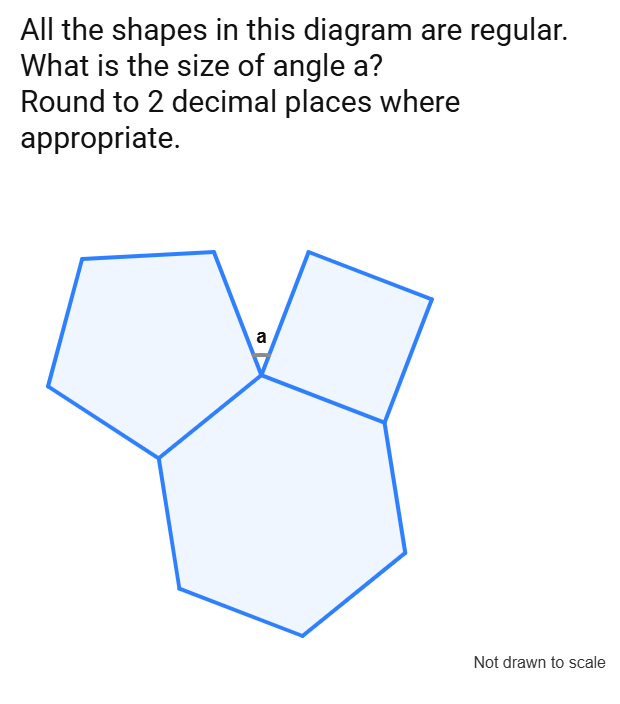
-
a = °
⌨️ Enter your answer in the field provided.
CorrectIncorrectHint
💡 Interior angles of polygons question: copy the diagram, count the sides of each regular polygon at the point, then find each interior angle and use angles around a point to get the missing angle.
Angles around a point add up to 360°.
An interior angle is the angle inside a polygon (a 2D shape with straight sides) where two sides meet.
For a regular polygon, every corner angle is the same, so you only need to find one interior angle.
Use the formula to find one interior angle when the shape has sides.
Write down the value of for each polygon before you calculate, so you do not mix them up.
Add the interior angles that meet at the point, then do to get the missing angle.
Use a calculator if you get decimals, and check your final angle is between 0° and 360°.
-
-
Question 8 of 15
8. Question
Topic: Polygon problems.

-
a = °
⌨️ Enter your answer in the field provided.
CorrectIncorrectHint
💡 Interior angles of polygons question: copy the diagram, count the sides of each regular polygon at the point, then find each interior angle and use angles around a point to get the missing angle.
Angles around a point add up to 360°.
An interior angle is the angle inside a polygon (a 2D shape with straight sides) where two sides meet.
For a regular polygon, every corner angle is the same, so you only need to find one interior angle.
Use the formula to find one interior angle when the shape has sides.
Write down the value of for each polygon before you calculate, so you do not mix them up.
Add the interior angles that meet at the point, then do to get the missing angle.
Use a calculator if you get decimals, and check your final angle is between 0° and 360°.
-
-
Question 9 of 15
9. Question
Topic: Polygon problems.

-
a = °
⌨️ Enter your answer in the field provided.
CorrectIncorrectHint
💡 Interior angles of polygons question: copy the diagram, count the sides of each regular polygon at the point, then find each interior angle and use angles around a point to get the missing angle.
Angles around a point add up to 360°.
An interior angle is the angle inside a polygon (a 2D shape with straight sides) where two sides meet.
For a regular polygon, every corner angle is the same, so you only need to find one interior angle.
Use the formula to find one interior angle when the shape has sides.
Write down the value of for each polygon before you calculate, so you do not mix them up.
Add the interior angles that meet at the point, then do to get the missing angle.
Use a calculator if you get decimals, and check your final angle is between 0° and 360°.
-
-
Question 10 of 15
10. Question
Topic: Polygon problems.

-
a = °
⌨️ Enter your answer in the field provided.
CorrectIncorrectHint
💡 Interior angles of polygons question: copy the diagram, count the sides of each regular polygon at the point, then find each interior angle and use angles around a point to get the missing angle.
Angles around a point add up to 360°.
An interior angle is the angle inside a polygon (a 2D shape with straight sides) where two sides meet.
For a regular polygon, every corner angle is the same, so you only need to find one interior angle.
Use the formula to find one interior angle when the shape has sides.
Write down the value of for each polygon before you calculate, so you do not mix them up.
Add the interior angles that meet at the point, then do to get the missing angle.
Use a calculator if you get decimals, and check your final angle is between 0° and 360°.
-
-
Question 11 of 15
11. Question
Topic: Polygon problems.
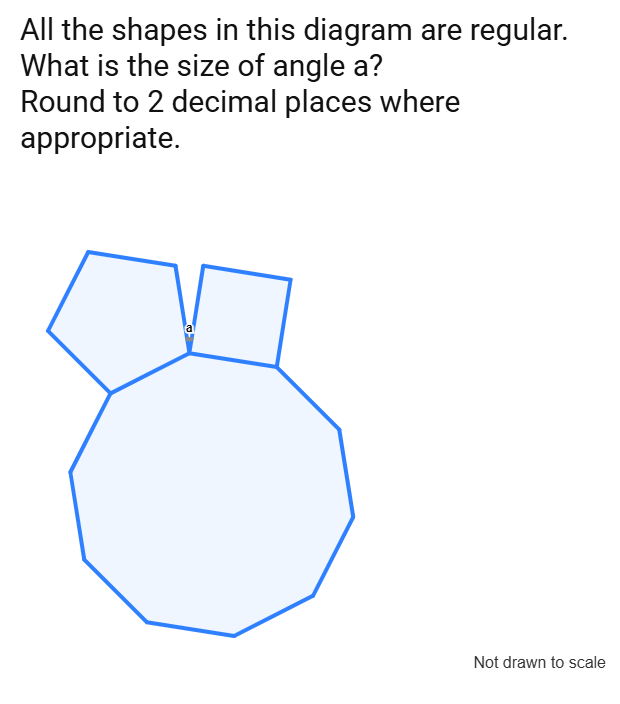
-
a = °
⌨️ Enter your answer in the field provided.
CorrectIncorrectHint
💡 Interior angles of polygons question: copy the diagram, count the sides of each regular polygon at the point, then find each interior angle and use angles around a point to get the missing angle.
Angles around a point add up to 360°.
An interior angle is the angle inside a polygon (a 2D shape with straight sides) where two sides meet.
For a regular polygon, every corner angle is the same, so you only need to find one interior angle.
Use the formula to find one interior angle when the shape has sides.
Write down the value of for each polygon before you calculate, so you do not mix them up.
Add the interior angles that meet at the point, then do to get the missing angle.
Use a calculator if you get decimals, and check your final angle is between 0° and 360°.
-
-
Question 12 of 15
12. Question
Topic: Polygon problems.

-
a = °
⌨️ Enter your answer in the field provided.
CorrectIncorrectHint
💡 Interior angles of polygons question: copy the diagram, count the sides of each regular polygon at the point, then find each interior angle and use angles around a point to get the missing angle.
Angles around a point add up to 360°.
An interior angle is the angle inside a polygon (a 2D shape with straight sides) where two sides meet.
For a regular polygon, every corner angle is the same, so you only need to find one interior angle.
Use the formula to find one interior angle when the shape has sides.
Write down the value of for each polygon before you calculate, so you do not mix them up.
Add the interior angles that meet at the point, then do to get the missing angle.
Use a calculator if you get decimals, and check your final angle is between 0° and 360°.
-
-
Question 13 of 15
13. Question
Topic: Polygon problems.

-
a = °
⌨️ Enter your answer in the field provided.
CorrectIncorrectHint
💡 Interior angles of polygons question: copy the diagram, count the sides of each regular polygon at the point, then find each interior angle and use angles around a point to get the missing angle.
Angles around a point add up to 360°.
An interior angle is the angle inside a polygon (a 2D shape with straight sides) where two sides meet.
For a regular polygon, every corner angle is the same, so you only need to find one interior angle.
Use the formula to find one interior angle when the shape has sides.
Write down the value of for each polygon before you calculate, so you do not mix them up.
Add the interior angles that meet at the point, then do to get the missing angle.
Use a calculator if you get decimals, and check your final angle is between 0° and 360°.
-
-
Question 14 of 15
14. Question
Topic: Polygon problems.

-
a = °
⌨️ Enter your answer in the field provided.
CorrectIncorrectHint
💡 Interior angles of polygons question: copy the diagram, count the sides of each regular polygon at the point, then find each interior angle and use angles around a point to get the missing angle.
Angles around a point add up to 360°.
An interior angle is the angle inside a polygon (a 2D shape with straight sides) where two sides meet.
For a regular polygon, every corner angle is the same, so you only need to find one interior angle.
Use the formula to find one interior angle when the shape has sides.
Write down the value of for each polygon before you calculate, so you do not mix them up.
Add the interior angles that meet at the point, then do to get the missing angle.
Use a calculator if you get decimals, and check your final angle is between 0° and 360°.
-
-
Question 15 of 15
15. Question
Topic: Polygon problems.

-
a = °
⌨️ Enter your answer in the field provided.
CorrectIncorrectHint
💡 Interior angles of polygons question: copy the diagram, count the sides of each regular polygon at the point, then find each interior angle and use angles around a point to get the missing angle.
Angles around a point add up to 360°.
An interior angle is the angle inside a polygon (a 2D shape with straight sides) where two sides meet.
For a regular polygon, every corner angle is the same, so you only need to find one interior angle.
Use the formula to find one interior angle when the shape has sides.
Write down the value of for each polygon before you calculate, so you do not mix them up.
Add the interior angles that meet at the point, then do to get the missing angle.
Use a calculator if you get decimals, and check your final angle is between 0° and 360°.
-